The holy places of France · Grand Est
Reims The Cathedral of the Coronations
Marne, Grand Est
- Feasts
- January 15, May 30
- Getting there
- About forty-five minutes by high-speed train from the Gare de l’Est in Paris.
- On our ways
- Via Cathedralis, Via Ioannae, Via Caritatis
Saint Remi and the baptism of Clovis
Saint Remi was born about 437 near Laon. He was elected bishop of Reims at 21, while still a layman, and governed the church for some seventy years until his death on January 13, 533.
Clovis, king of the Franks, had married Clotilde, a Burgundian princess, and Remi worked for his conversion with her help and that of Saint Vedast. After a victory over the Alamanni, Clovis asked Remi to baptize him. The baptism took place at Reims on Christmas Day, in a year traditionally given as 496, and Gregory of Tours writes that some three thousand Franks were baptized with their king.
Most of the Germanic peoples then settled in the old Roman provinces were Arian Christians. Clovis received the Catholic faith of the Council of Nicaea, and through him that faith took root among the Franks. Because of this baptism, France has long been called the eldest daughter of the Church, and its memory inspired the custom of crowning the kings at Reims.
The coronations and the Holy Ampulla
In 816 Pope Stephen IV crowned the emperor Louis the Pious at Reims, and from the coronation of Henry I in 1027 the rite was held in the cathedral almost without a break. Seven kings of France were not crowned there: Hugh Capet, Robert II, Louis VI, John I, Henry IV, Louis XVIII and Louis-Philippe. Henry IV was crowned at Chartres. The last coronation at Reims was that of Charles X in 1825.
The kings were anointed with oil from the Holy Ampulla. According to a tradition that goes back to Archbishop Hincmar of Reims in the ninth century, a dove brought this small flask from heaven for the baptism of Clovis. The ampulla was broken during the Revolution, and a fragment of it is kept in the flask that replaced it. Before his coronation the king stayed in the archbishop’s palace beside the cathedral, the Palais du Tau, and the coronation banquet was held there afterward.
Joan of Arc and July 17, 1429
After she raised the siege of Orléans, Joan of Arc urged Charles VII to go to Reims for his coronation. The army left Gien on June 29, 1429. Auxerre surrendered on July 3, and Troyes, the only town to resist, gave way after negotiations. Reims opened its gates on July 16, and the next morning, July 17, 1429, Charles was anointed and crowned in the cathedral, with Joan given a place of honor at the ceremony.
Joan was captured at Compiègne the following year and burned at Rouen in 1431. Pope Benedict XV canonized her on May 16, 1920, and two years later she was declared a patroness of France. An equestrian statue of her stands outside the cathedral, and inside, a statue of 1901 stands in the chapel dedicated to her. Our Via Ioannae follows her road from Domrémy through Reims to Rouen, and the six hundredth anniversary of her mission falls in 2029.
Reading the cathedral
The present cathedral replaced one destroyed by fire on May 6, 1210. The first stone was laid a year later, and the structure was complete by 1275. The names of four master masons, Jean d’Orbais, Jean-le-Loup, Gaucher of Reims and Bernard of Soissons, were set in a labyrinth in the nave floor, which was destroyed in 1779. The church is about 489 feet long, and its towers rise to about 266 feet.
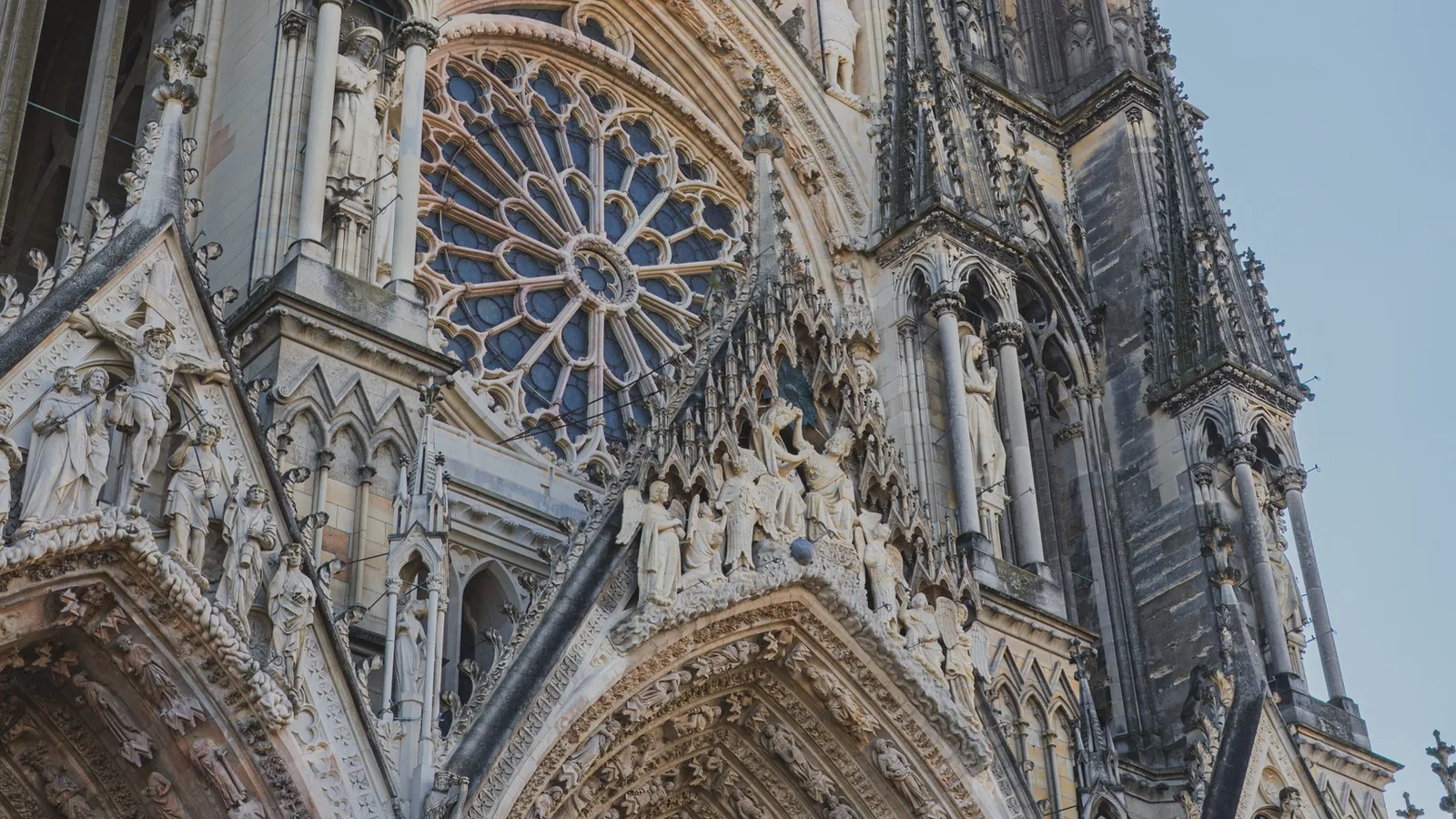
Start at the west front. The central portal is given to the Virgin, and the gable above it showed her Coronation; the original gable is now kept in the Palais du Tau. On the left-hand portal, on the north side, is the Smiling Angel, damaged in 1914 and later restored to its place. The great rose window above shows the Dormition of the Virgin at its center, surrounded by the apostles, angel musicians, and kings and prophets of the Old Testament. Higher still runs the Gallery of Kings, fifty-six statues about 15 feet tall, with Clovis at the center between Clotilde and Saint Remi.
Once inside, turn back toward the doors. The inner face of the west wall is covered with sculpture. Among its scenes are the Communion of the Knight, in which Abraham receives bread and wine from the priest-king Melchizedek, and a baptism of Christ that recalls the baptism of Clovis, together with scenes of the Apocalypse and saints of Reims such as Saint Nicaise.
Much of the thirteenth-century glass of the nave was lost, and the gaps have been filled with old and modern glass. The north rose of the transept, showing the Creation, keeps much of its original glass, while the south rose was destroyed by a hurricane in 1580 and replaced with simpler tracery. In the axial chapel at the east end are the three windows Marc Chagall made with the glass painter Charles Marq, showing the Tree of Jesse, the Old and New Testaments, and the great hours of Reims. On either side, six windows by the German artist Imi Knoebel were inaugurated on June 25, 2011, for the cathedral’s eight hundredth anniversary. Jacques Simon’s windows of the 1950s, in the chapel of Saint Remi in the south transept, celebrate champagne and Dom Pérignon.
The shelling of 1914 and the restoration
In September 1914, in the first weeks of the First World War, wounded soldiers were laid in the nave on some 15,000 bales of straw. On September 19 German shells struck the timber framework of the roof and set it on fire. The fire destroyed the roof and melted the bells. Molten lead from the roof poured out through the gargoyles.
Restoration began in 1919 under Henri Deneux, chief architect of historic monuments, and the American John D. Rockefeller Jr. gave generously toward it from 1924. Deneux used modern materials, among them prefabricated reinforced concrete. The cathedral reopened in 1938, the year its new great organ was inaugurated. In July 1962 Charles de Gaulle and Konrad Adenauer met in the cathedral to mark the reconciliation of France and Germany. In 1991 the cathedral, the former abbey of Saint-Remi and the Palais du Tau were inscribed together on UNESCO’s World Heritage List.
Saint-Remi and the Palais du Tau
The basilica of Saint-Remi was built in the eleventh century over the chapel of Saint Christopher, where Remi had been buried, and Pope Leo IX consecrated it in 1049. Its Romanesque nave and transepts are the oldest parts, while the choir and apse chapels are Gothic work of the twelfth and thirteenth centuries. It is the largest Romanesque church in northern France.
The relics of Saint Remi were first kept in the cathedral. Archbishop Hincmar carried them to Épernay during the Viking raids, and in 1099 they were brought to the abbey of Saint-Remi. On October 7, 1793, a commissioner of the Convention desecrated the saint’s tomb because of its link with the monarchy. Shelling in the First World War left the basilica in ruins, and Henri Deneux spent some forty years rebuilding it. It is still a parish church, and pilgrims come to pray at the tomb of the bishop who baptized Clovis.
Beside the cathedral, the Palais du Tau takes its name from its plan, shaped like the Greek letter tau. Its chapel of 1207 is the oldest part. The palace was rebuilt between 1498 and 1509 and again between 1671 and 1710. Since 1972 it has housed the museum of the cathedral, with original statues and tapestries from the building and what remains of the treasury of the coronations. It is now closed for restoration and is being refitted as a museum of the coronations, and the Reims tourist office announces the date of its reopening.
Saint John Baptist de La Salle
Saint John Baptist de La Salle, founder of the Brothers of the Christian Schools, was born in Reims on April 30, 1651. He was named a canon of the cathedral as a teenager and was ordained a priest on April 9, 1678. In 1679 he helped a schoolmaster, Adrien Nyel, open a school for poor children in Reims. In 1680 he invited the teachers to eat at his house, and in 1681 he brought them to live with him. That household of teachers was the beginning of the Brothers.
La Salle resigned his canonry to give all his time to the schools, sold what he owned and gave the money to the poor of Champagne during a famine. In 1685 he founded in Reims what is generally considered the first school for training teachers. He died at Saint-Yon, near Rouen, on Good Friday, April 7, 1719. Pope Leo XIII canonized him on May 24, 1900, and on May 15, 1950, Pope Pius XII named him patron of teachers. His principal shrine is now at the Brothers’ generalate in Rome, and in Reims pilgrims pray for his intercession in the cathedral where he served as a canon. He is one of the saints of our Via Caritatis, and Reims is the last stop of Via Cathedralis.
Further reading: Rouen: A Pilgrim’s Guide to the City of Saint Joan of Arc; Chartres: A Pilgrim’s Guide to the Cathedral of Our Lady; Joan of Arc in France: The Places of Her Life.
To see and to pray
- The cathedral of Notre-DameThe Smiling Angel, the west rose and the Chagall windows.
- The basilica of Saint-RemiThe tomb of the bishop who baptized Clovis, in a Romanesque abbey church.
- The Palais du TauThe archbishop’s palace and the treasury of the coronations, closed for restoration; check the reopening date with the Centre des monuments nationaux.
When to go
The cathedral is open every day from early morning, and entry is free; on Sunday mornings visitors stay in the entrance area during Mass. From late May to early October, and again at the end of the year, a free light show called Regalia lights the west front in the evening.
The city keeps the memory of Joan of Arc at the end of May. The Palais du Tau, the former archbishop’s palace with the treasury of the coronations, is closed for restoration and is due to reopen as a museum of the coronations; check the date with the Centre des monuments nationaux before you come.
Mass and prayer
Mass is celebrated every day, and on Sunday morning in Gregorian chant; the cathedral’s website gives the current times of Mass, confession and adoration. Confessions are heard on Wednesday and Friday afternoons, and the Blessed Sacrament is adored each weekday morning. The cathedral offers no Mass or tours in English; the tourist office runs a guided tour in English on Saturday afternoons.
Walking and access
The cathedral stands on level ground in the center of the city. The towers, 249 steps with no elevator, are closed from mid-November to mid-February. The basilica of Saint-Remi is about a mile south of the cathedral.
Feasts
- January 15, in France; January 13 in the Roman MartyrologyFeast of Saint Remi
- May 30, in FranceFeast of Saint Joan of Arc
- April 7Feast of Saint John Baptist de La Salle
- June 4, in France; June 3, the day of her death, outside FranceFeast of Saint Clotilde
- October 6Feast of Saint Bruno
- August 25Feast of Saint Louis
The saints of this place
- Saint RemiBishop of Reims, who baptized Clovis
- Saint Joan of ArcThe Maid of Orléans, secondary patroness of France
- Saint John Baptist de La SalleFounder of the Brothers of the Christian Schools
- Saint ClotildeQueen of the Franks, wife of Clovis
- Saint BrunoFounder of the Carthusian Order
- Saint LouisKing of France
On our ways
- Via CathedralisThe Cathedral Way, seven daysDay V, Amiens, then Reims · Day VI, Reims · Day VII, Reims, then Paris-Charles de Gaulle
- Via IoannaeJoan’s Way, eight daysDay VI, Orléans to Reims · Day VII, Reims to Rouen, by Compiègne
- Via CaritatisThe Way of Charity, seven daysDay III, Paris to Reims · Day V, Reims to Lyon
Getting there
About forty-five minutes by high-speed train from the Gare de l’Est in Paris.
The shrine’s own website, for times and news: cathedrale-reims.com
Questions
Is Reims cathedral free?
Yes. The towers are paid and are visited at set times; book on the Centre des monuments nationaux website.
How long should we allow for Reims?
Half a day for the cathedral and Saint-Remi; a full day with a Champagne house, or with the Palais du Tau once it reopens.
How do we get to Reims?
By high-speed train from the Gare de l’Est in Paris in about forty-five minutes, or from Paris-Charles de Gaulle airport to the Champagne-Ardenne TGV station, just outside the city, in about thirty minutes.
Sources
- Reims Cathedral (Wikipedia)
- Saint Remigius (Wikipedia)
- Basilica of Saint-Remi (Wikipedia)
- Palace of Tau (Wikipedia)
- Joan of Arc (Wikipedia)
- Jean-Baptiste de La Salle (Wikipedia)
- Office de tourisme du Grand Reims
- Brothers of the Christian Schools, official site (75th anniversary of the patronage of educators)
Facts checked against these sources on .
Nearby
- WarmerivilleVal-des-Bois, about 11 miles as the crow flies
- CompiègneThe Town Where Joan of Arc Was Taken, about 55 miles as the crow flies
- Noisy-le-GrandNotre-Dame-des-Sans-Logis, about 73 miles as the crow flies
- Saint-DenisThe Basilica of Saint-Denis, about 79 miles as the crow flies