The holy places of France · Centre-Val de Loire
Chartres The Cathedral of Notre-Dame of Chartres
Eure-et-Loir, Centre-Val de Loire
- Getting there
- About an hour and ten minutes by train from the Gare Montparnasse in Paris.
- On our ways
- Via Cathedralis, Via Gratiae
The Veil of the Virgin
Pilgrims have come to Chartres for more than eleven hundred years to pray before a relic of the Virgin Mary. In 876 the emperor Charles the Bald gave the cathedral a length of silk venerated as her veil. According to tradition it had come from Constantinople to his grandfather Charlemagne, and Mary wore it at the Annunciation. Until the eighteenth century it was called the Sancta Camisia, the holy tunic. When its cedar chest was opened early in that century, the cloth proved to be a long veil for the head.
Women invoked the relic before childbirth, and soldiers before battle. Saint Louis came on pilgrimage five times, and Henry IV was crowned in the cathedral, one of the few kings of France crowned outside Reims.
During the Revolution the veil was cut into pieces, which were dispersed. In 1927 the silk museum of Lyon examined the largest surviving piece and judged it a costly silk of the first centuries of the Christian era. Since 1876, the thousandth anniversary of the gift, it has been kept in a reliquary by the Paris goldsmith Placide Poussielgue-Rusand, shown in the chapel of the Martyrs on the north side of the ambulatory. On August 15, the feast of the Assumption, the reliquary is carried in procession through the town.
The fire of 1194 and the new cathedral
On the night of June 10, 1194, fire destroyed the Romanesque cathedral, sparing only the crypt, the west towers and the new west front. The veil was thought lost until, three days later, the clergy who had sheltered it in the crypt brought it out unharmed. Offerings poured in once the news spread, and they helped to pay for a new church, begun at once on the old foundations.
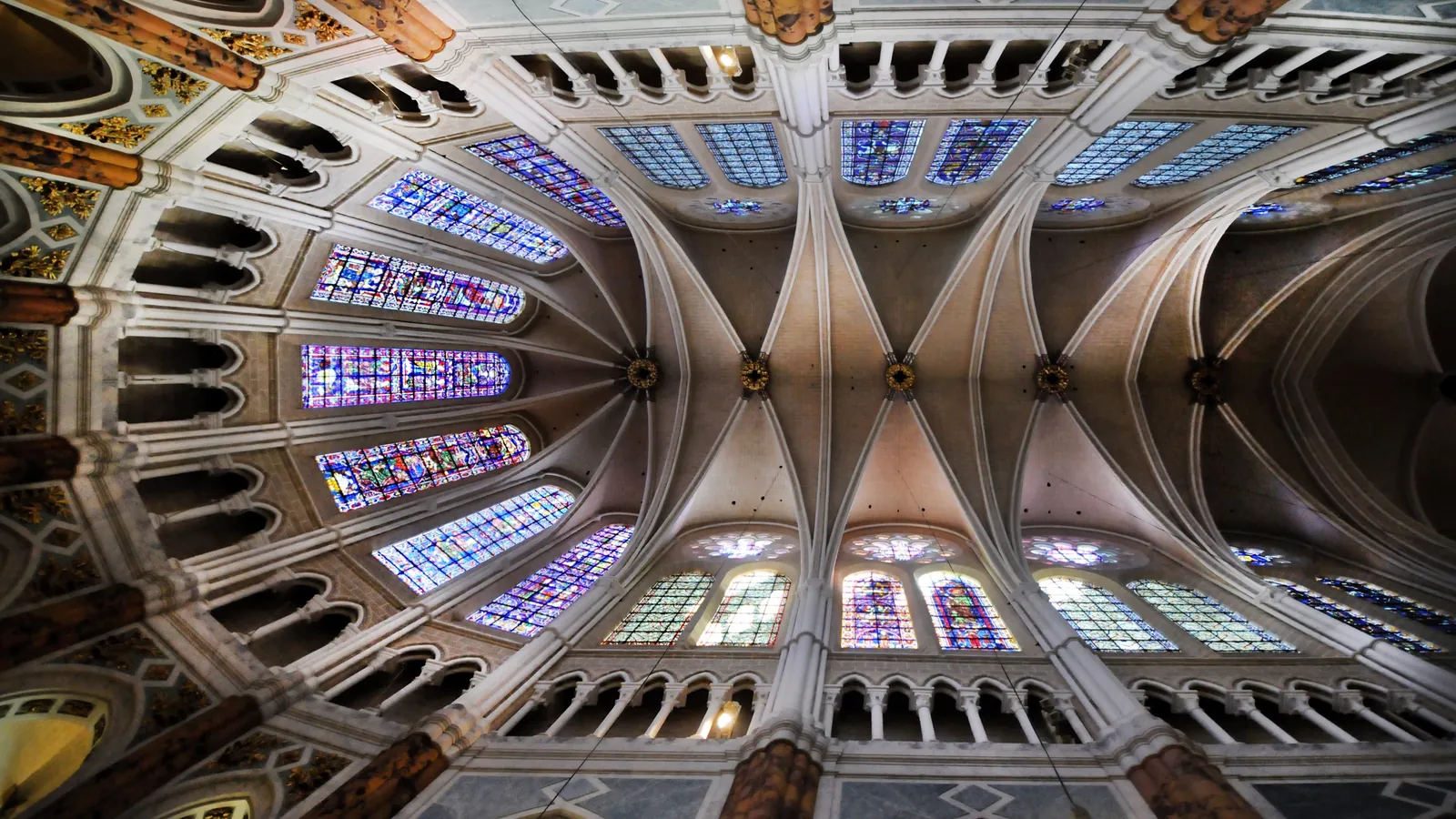
The roof was in place by about 1220, and the cathedral was consecrated in October 1260 in the presence of Saint Louis. It has kept most of its medieval sculpture and its 176 windows, the great majority of the twelfth and thirteenth centuries. The plain south spire is of the twelfth century, and the taller north spire, in the Flamboyant Gothic style, was built by Jehan de Beauce between 1507 and 1513. UNESCO inscribed the cathedral on the World Heritage List in 1979.
The Royal Portal and the porches
The visit starts at the west front. The Royal Portal, carved between about 1145 and 1155, survived the fire, and its three doors are given to Christ. Over the central door he sits in majesty among the symbols of the four evangelists. The right-hand door tells of the Incarnation, with the Virgin enthroned and the Child on her knees as the Seat of Wisdom, and the left-hand door is usually read as the Ascension. Column statues of kings and queens of the Old Testament line the doorways. The three lancet windows above, of about 1145, also escaped the fire. They show the Tree of Jesse, the life of Christ and the Passion, in the deep blue first made at the works of Saint-Denis in the 1140s.
The transept porches were added in the thirteenth century. The north porch is given to the Old Testament and to the Virgin. On the pillar of its central door Saint Anne holds the infant Mary, and above the door the death and Assumption of Mary lead up to her Coronation. The south porch is given to the time after the Crucifixion. On its central pillar Christ stands on a lion and a dragon below the Last Judgment, with the martyrs on the left-hand door and the confessors on the right, among them Saint Nicholas and Saint Martin of Tours.
The windows, the choir screen and the labyrinth
In the south ambulatory, just beyond the transept, is Notre-Dame de la Belle Verrière, often called the Blue Virgin. Its upper part, the Virgin enthroned with the Child, is glass of about 1180 that survived the fire, and the scenes of Christ’s childhood below it were added about 1225.
The west rose, of about 1215 and nearly 40 feet across, shows the Last Judgment. The north rose, of about 1230, is given to the Virgin and was the gift of Queen Blanche of Castile, mother of Saint Louis. The south rose shows Christ in glory among the twenty-four Elders of the Apocalypse, and in the lancets beneath it the four evangelists sit on the shoulders of four prophets, the New Testament resting on the Old.
At the north entrance to the ambulatory stands Our Lady of the Pillar, a pearwood statue of about 1540 that draws the strongest popular devotion in the cathedral. By custom children are consecrated to Our Lady before it. Around the choir runs the stone screen begun in 1514 to designs by Jehan de Beauce and completed early in the eighteenth century, about 330 feet long, with forty groups of statues telling the lives of the Virgin and of Christ.
The labyrinth in the floor of the nave was laid around 1200. It measures about 42 feet across, and a single path of some 858 feet winds to its center, a figure of the heavenly Jerusalem. Chairs cover it most of the year. On Fridays from the start of Lent to the end of October they are moved aside so that it can be walked.
The crypt and Our Lady Underground
Below the upper church lies the crypt built by Bishop Fulbert after the cathedral of his day was destroyed in 1020. Finished about 1024, it is the largest crypt in France, a vaulted gallery more than 650 feet long, and it too survived the fire of 1194.
The chapel of Notre-Dame de Sous-Terre, Our Lady Underground, has been a place of prayer probably since the twelfth century. A local tradition holds that the Druids honored on this spot a “virgin who will give birth.” The Romanesque statue of the Virgin and Child venerated here was burned in 1793, and the statue on the altar today is a copy. Nearby is the well of the Saints-Forts, about 110 feet deep, into which, by tradition, early martyrs of Chartres were thrown. The crypt is shown on guided visits, and the cathedral’s website gives the times.
The restoration of the interior
Until the restoration the interior was dark, blackened by candles, incense and the soot of an old oil furnace. In 2008 the state’s heritage service began a long restoration under the chief architect Patrice Calvel. Restorers found that about four-fifths of the thirteenth-century finish survived beneath the grime, a pale ocher wash with white lines painted to mark the joints of the stones. Missing areas were filled with a matching wash. The choir, the ambulatory and the nave were finished in the 2010s.
The result divided opinion. The American critic Martin Filler called it a desecration, and others argued that the brighter walls weaken the effect of the windows. Those in charge pointed out that most of what visitors see is the medieval finish itself. When Our Lady of the Pillar was cleaned in 2013, her face came out pale from under soot and black paint. The choir screen was restored between 2015 and 2022, work on the transept began in 2021, and a new organ is being built in the restored case. Since September 2024 the treasury has been shown again, in the restored chapel of Saint-Piat.
Péguy and the walk from Paris
The walking pilgrimages of modern times go back to the poet Charles Péguy. In 1912, at the bedside of his gravely ill son Pierre, he vowed to go to Chartres on foot if the boy recovered. That June he walked from his home at Lozère, near Palaiseau south of Paris, to the cathedral. He made the walk again in July 1913, the year he published La Tapisserie de Notre-Dame, with his poem presenting the plain of the Beauce to Our Lady. He was killed on September 5, 1914, at the start of the Battle of the Marne. The Chemin Charles Péguy, a waymarked trail of about 59 miles, follows his route.
In 1935 a group of Sorbonne students took up Péguy’s road. Their pilgrimage drew more than ten thousand young people a year in the 1960s and still takes place each spring, organized by the dioceses of the Paris region for young adults aged 18 to 30.
Since 1983 a Pentecost pilgrimage now run by the lay association Notre-Dame de Chrétienté has left Paris on the Saturday and reached Chartres on the Monday, about 60 miles on foot, with Mass in the traditional Latin rite. The 44th pilgrimage, from May 23 to 25, 2026, drew nearly 20,000 walkers from 22 countries and ended with a Pontifical Mass in the cathedral. A shorter route of about 43 miles is now offered, and places often fill weeks before the start. Groups who prefer to come by coach or train will find Chartres on Via Cathedralis and Via Gratiae.
Further reading: Reims: A Pilgrim’s Guide to the Cathedral of the Coronations; Black Madonnas of France: A Pilgrim’s Guide; Catholic Pilgrimage to France: A Practical Planning Guide.
To see and to pray
- The Veil of the VirginIn its reliquary, in a chapel of the ambulatory.
- The windowsNotre-Dame de la Belle Verrière, and the three rose windows.
- The cryptThe largest in France, with the statue of Our Lady Underground.
- The labyrinthIn the floor of the nave.
When to go
The cathedral is open every day of the year from 8:30 a.m. to 7:30 p.m., and entry is free. The labyrinth is cleared for walking on Fridays, from the start of Lent to the end of October.
At Pentecost thousands of pilgrims walk from Paris to Chartres over three days and fill the cathedral for the closing Mass. August 15, the patronal feast, is kept with a procession through the town.
Mass and prayer
Mass is celebrated each day, at midday in the crypt and in the evening in the cathedral, with Vespers afterward; on Sunday the 9 a.m. Mass is sung in Gregorian chant. The rosary is prayed each afternoon before Our Lady of the Pillar. There is no regular Mass in English.
The crypt is kept for prayer and is shown on a pilgrims’ visit; its days and hours vary, so ask at the cathedral.
Walking and access
The ground floor of the cathedral is fully accessible, with a ramp at the Royal Portal, and wheelchairs can be borrowed. The climb to the upper levels is about two hundred steps on a spiral stair. Coaches stop about three hundred yards from the cathedral, and a free town shuttle runs from Monday to Saturday.
On our ways
Getting there
About an hour and ten minutes by train from the Gare Montparnasse in Paris.
The shrine’s own website, for times and news: cathedrale-chartres.org/en
Questions
Is Chartres cathedral free?
Yes. The treasury and the upper levels, kept by the national monuments center, cost €7.
Are there tours in English?
Yes. Tours in English are offered in season, and in summer the tourist office runs its own English tour; check the days and times on the cathedral’s and the tourist office’s websites before you come. Groups of ten or more use audio guides or an accredited guide.
How long does a visit take?
Allow half a day: the cathedral, the Veil of the Virgin and the windows, with time for Mass, the crypt or the labyrinth.
How do we get to Chartres from Paris?
By train from the Gare Montparnasse, in about an hour.
Sources
- Chartres : le trésor de la cathédrale rouvre au public (Aleteia, 2024)
- Chartres, le voile de la Vierge (Étoile Notre-Dame)
- Chartres, le labyrinthe (Étoile Notre-Dame)
- Chartres (Catholic Encyclopedia, Catholic Online)
- Chartres Cathedral (Encyclopaedia Britannica)
- Cathédrale Notre-Dame de Chartres (Ministère de la Culture, DRAC Centre-Val de Loire)
- 21st Century Chartres: The Famous Gothic Cathedral is Newly Restored (France Today)
- Chartres : un nouveau pélé, « pour mieux se rassembler » (Diocèse de Paris)
- Charles Péguy, Lieutenant of the 276th Infantry Regiment (Circuit de la bataille de la Marne)
- Young Catholics drive record crowds for Chartres Pilgrimage in France (Catholic World Report, 2026)
Facts checked against these sources on .
Nearby
- OrléansThe City Joan of Arc Set Free, about 42 miles as the crow flies
- MontligeonThe Shrine of Our Lady of Montligeon, about 43 miles as the crow flies
- Issy-les-MoulineauxThe Seminary of Saint-Sulpice, about 44 miles as the crow flies
- Ivry-sur-SeineThe House of Madeleine Delbrêl, about 48 miles as the crow flies