Saint Martin of Tours
Soldier, monk and bishop of Toursc. 316–397
Feast · November 11
- Where to pray
- Tours, Candes-Saint-Martin, Ligugé
- Patron of
- some four thousand parishes in France that bear his name.
Life
Martin was born at Sabaria in Pannonia, now Szombathely in Hungary, about 316, to pagan parents; his father was an officer of the Roman army. He grew up at Pavia in Italy, and at the age of ten, against his parents’ wishes, he asked to be received among the catechumens. At fifteen, under a law that obliged the sons of veterans to serve, he was enrolled in the cavalry.
In a hard winter, at the gate of Amiens, he met a beggar who had almost nothing to wear. Martin, who had only his weapons and his soldier’s cloak, cut the cloak in two and gave the man half. That night, according to his disciple and biographer Sulpicius Severus, he saw Christ wearing the half cloak and heard him say, “Martin, yet a catechumen, has clothed me with this garment.” He was baptized at eighteen and left the army some two years later.
He joined Saint Hilary, bishop of Poitiers, who wished to ordain him deacon, and out of humility Martin accepted only the order of exorcist. He went back to Pannonia and converted his mother, was scourged by the Arians in Illyricum, was driven from Milan and lived as a hermit on the island of Gallinaria. In 361 he settled on land near Poitiers that Hilary gave him, at Ligugé, and founded there the oldest monastery known in western Europe.
In July 371 the people of Tours chose him as their bishop. He founded the monastery of Marmoutier, about two miles from the city, where he trained monks who later became bishops, and he went through the countryside pulling down pagan temples and sacred trees. At Trier he opposed the execution of heretics and rebuked the bishop who had accused them. He died at Candes on November 8, 397, lying on ashes, and said before his death, “Abraham’s bosom is open to receive me.”
Cult and relics
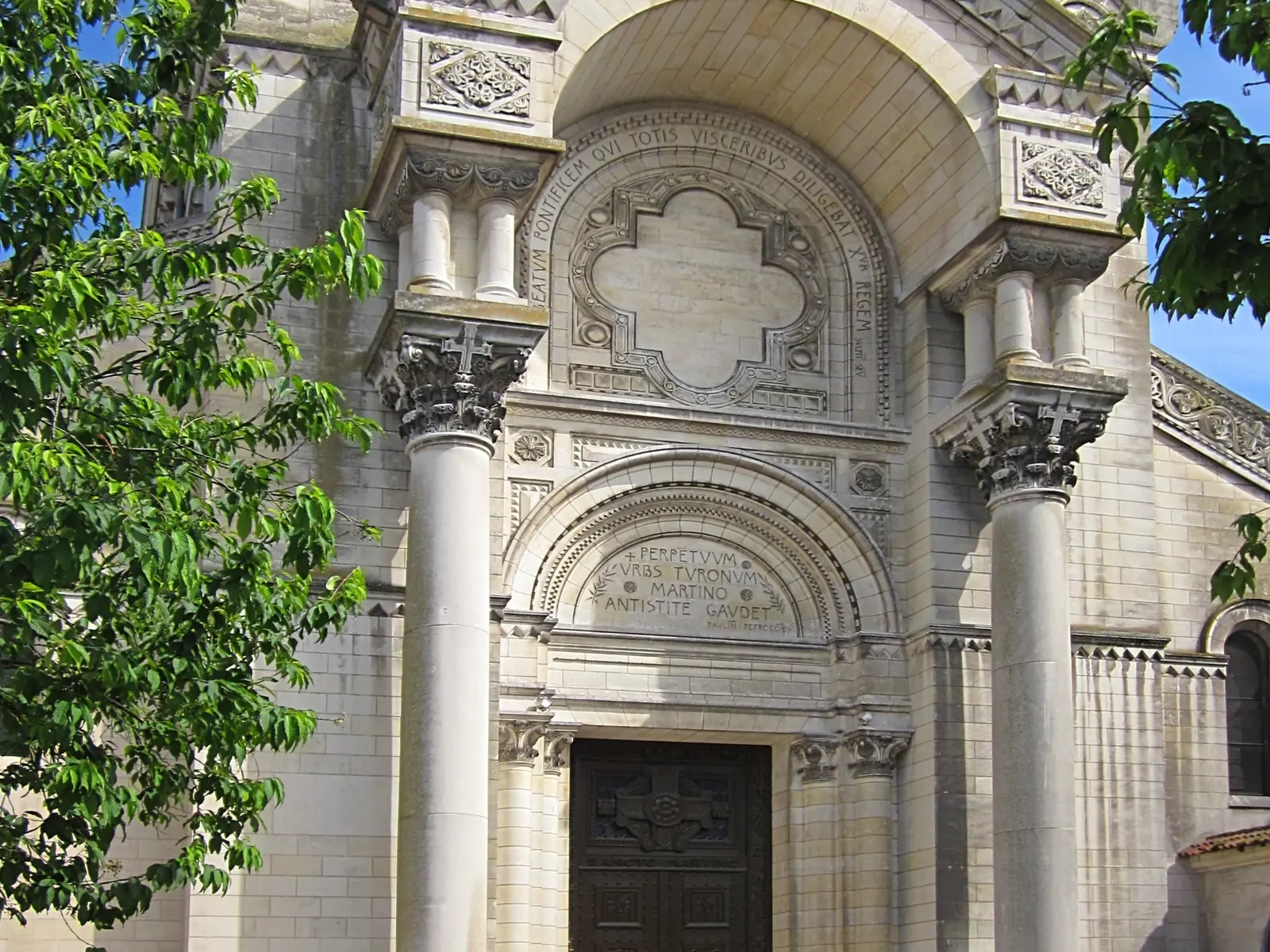
His body was carried to Tours, and his feast is kept on November 11. A chapel rose over his grave in 437 and a basilica in 471, consecrated on July 4 of that year, and from the ninth century the tomb was a stop on the road to Compostela. In 1562 the basilica was pillaged and the saint’s body burned. During the Revolution the church was turned into a stable; its vaults collapsed in 1797, and it was then demolished, except for the Charlemagne tower and the clock tower, as streets were laid across the site. On December 14, 1860, Léon Papin-Dupont found the tomb beneath a house. The present basilica, designed by Victor Laloux, was begun in 1887 and consecrated in 1925, and its crypt keeps the tomb. More than four hundred towns and four thousand parishes in France bear his name.
In art
Martin is most often shown on horseback dividing his cloak for the beggar, or in the vestments of a bishop. At Candes the north porch of the collegiate church, finished about 1250 as the pilgrims’ entrance, has fourteen statues, and a window in the chapel of Saint Martin shows the monks of Tours carrying his body away by night. In the crypt at Tours the tomb is built of marble and pink sandstone from the Vosges and decorated with mosaics.
Patron of
Patron of some four thousand parishes in France that bear his name.
Where to pray
- ToursThe basilica of Saint-Martin, consecrated in 1925, with his tomb in the crypt.
- Candes-Saint-MartinThe collegiate church, now a parish church, whose chapel of Saint Martin stands by tradition where he died on November 8, 397.
- LigugéThe Benedictine abbey of Saint-Martin near Poitiers, on the site of the monastery he founded in 361, restored by monks of Solesmes in 1853.
On our ways: Tours.