Saint Remi
Bishop of Reims, who baptized Clovisc. 437–533
Feast · January 15, in France; January 13 in the Roman Martyrology
- Where to pray
- Reims
Life
Remi, Remigius in Latin, was born about 437 at Laon or at nearby Cerny, into a Gallo-Roman family. His father, Emilius, was count of Laon, and tradition names his mother as Saint Celina, who bore him in her old age. His brother Principius became bishop of Soissons. Remi studied at Reims, and in his twenty-second year, while still a layman, he was chosen bishop of the city.
He governed the Church of Reims for more than seventy years. With Saint Vedast and Queen Clotilde he worked for the conversion of Clovis, king of the Franks. After a victory over the Alamanni, Clovis asked Remi for baptism and received it at Reims at Christmas, in a year traditionally given as 496 that historians place between 496 and 499. According to Gregory of Tours, some three thousand Franks were baptized with him. Because the king of the Franks received the Catholic faith through this baptism, France has long been called the eldest daughter of the Church.
With land that Clovis gave him, Remi founded and endowed churches, and with the consent of the pope he set up bishoprics at Tournai, Cambrai and Thérouanne, at Arras, where he placed Saint Vedast, and at Laon, which he gave to Gunband, a member of his family. In 530 he consecrated Saint Medard bishop of Noyon. Four of his letters survive, two of them written to Clovis. He died at Reims on January 13, 533.
Further reading: Reims: A Pilgrim’s Guide to the Cathedral of the Coronations.
Cult and relics
He was buried at Reims in the chapel of Saint Christopher, and his relics were later kept in the cathedral. Archbishop Hincmar carried them to Épernay during the Viking raids, and it was Hincmar, in the ninth century, who first told how a dove brought the Holy Ampulla from heaven for the baptism of Clovis; its oil anointed the kings of France at their coronation in Reims. In the eleventh century an abbey church was built over the chapel where Remi had been buried. Pope Leo IX consecrated it in October 1049 and at the same time translated the saint’s body into it. On October 7, 1793, a commissioner of the Convention desecrated the tomb. Shelling in the First World War left the basilica in ruins, and the architect Henri Deneux spent some forty years rebuilding it. Since 1991 it has been part of a UNESCO World Heritage site with the cathedral and the Palais du Tau.
In France his feast is kept on January 15, and the Roman Martyrology names him on January 13, the day of his death. In the General Roman Calendar of 1960 his feast fell on October 1, the date of the translation of his relics.
In art
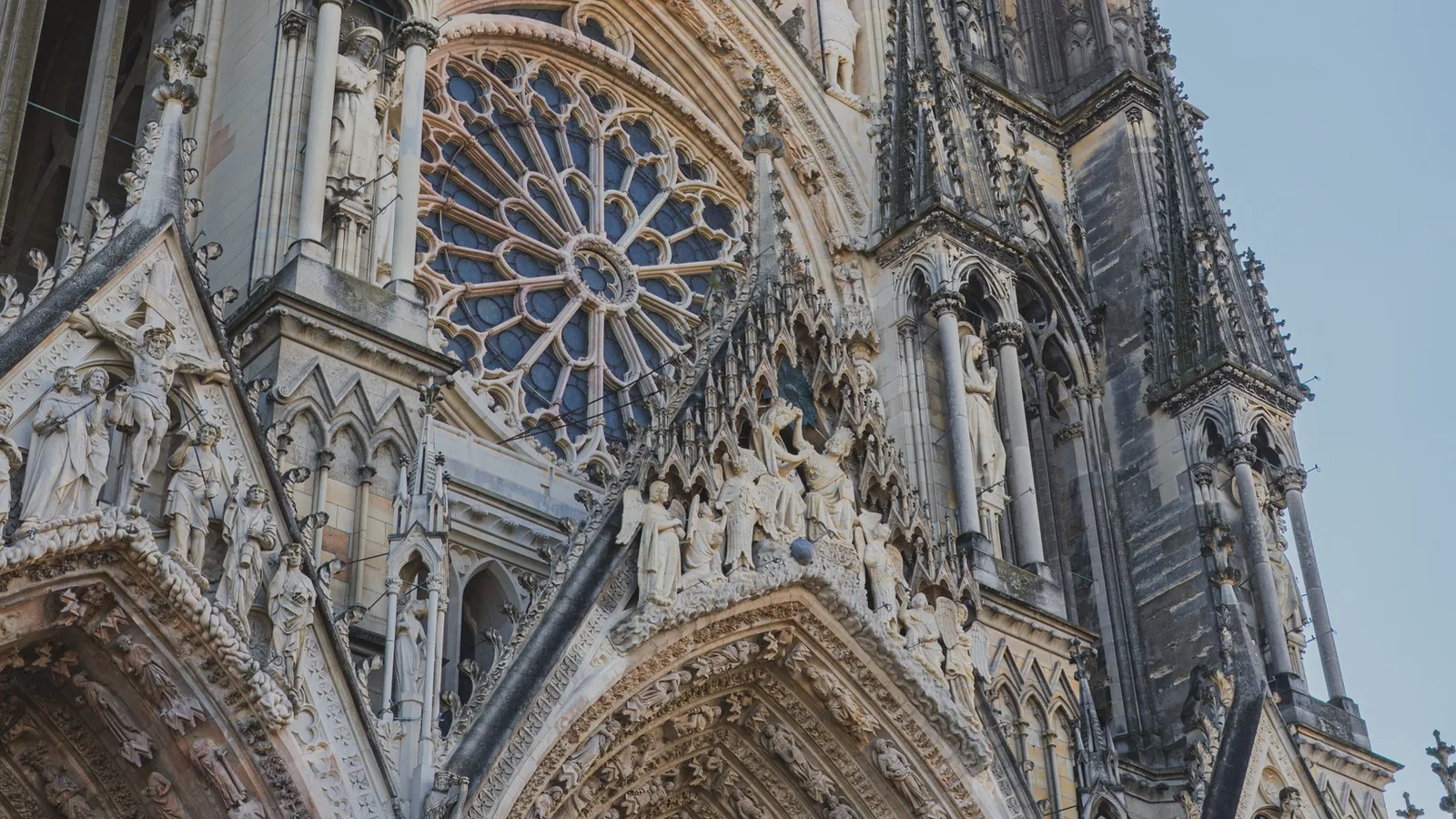
Remi is shown as a bishop with a dove, which recalls the legend of the Holy Ampulla, and sometimes with a book or a lamp. On the west front of the cathedral of Reims, the Gallery of Kings sets Clovis at its center between Clotilde and Saint Remi.
Where to pray
- Reims, basilica of Saint-RemiThe former abbey church built over his grave, with his tomb, rebuilt after the First World War and still a parish church.
- Reims, cathedral of Notre-DameThe cathedral of the coronations, where Saint Remi stands beside Clovis and Clotilde in the Gallery of Kings on the west front.
On our ways: Reims.