The holy places of France · Auvergne-Rhône-Alpes
Le Puy-en-Velay The Cathedral of Notre-Dame du Puy
Haute-Loire, Auvergne-Rhône-Alpes
- Feasts
- September 29, August 15
- Getting there
- About an hour and a quarter by road from Saint-Étienne, which is under three hours from Paris by high-speed train.
- On our ways
- Via Gratiae, Via Conchae
The traditions of Mont Anis
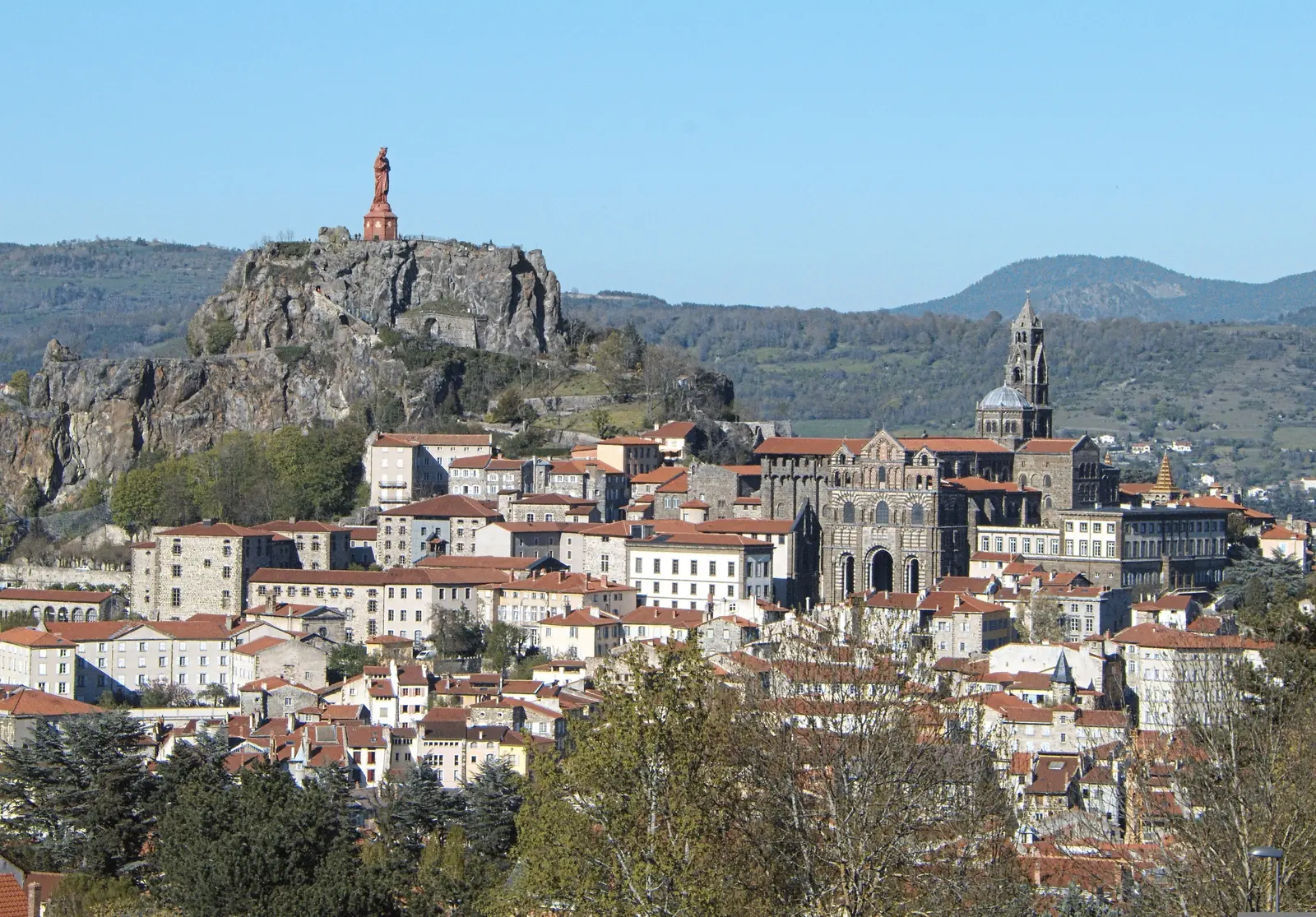
The cathedral of Le Puy stands on Mont Anis, a volcanic hill at the top of the old town. Pilgrims have prayed to Our Lady on this hill since the early Middle Ages, and the beginnings of the shrine are known through traditions written down long after the events they tell.
According to the oldest of them, a woman named Vila, ill with fever, was laid on the flat slab of a dolmen on the hilltop. She fell asleep, saw the Virgin in a dream, and woke up cured; Our Lady had asked for a church on that spot. The legend adds that Bishop George climbed the hill in mid-July, found it under snow, and saw a stag trace in the snow the outline of the church to come. The Catholic Encyclopedia notes that the historian Louis Duchesne dated the related legend making Bishop George one of the seventy-two disciples no earlier than the eleventh century, and it judges it probable that Saint Vosy completed the church and moved the bishop’s seat from the Roman town of Ruessium to Anis.
The stone of the story is still in the cathedral. Known as the fever stone, it kept its name after the dolmen was taken down, and for centuries the sick slept on it or beside it. It now lies in a chapel of the cathedral, and pilgrims still stop there to pray. Pope Pius IX gave the cathedral the rank of minor basilica by a decree of February 11, 1856.
The Black Virgin and the jubilee
Tradition says that Saint Louis gave the cathedral its Black Virgin, a seated Virgin holding the Child, in 1254, on his way home from the crusade. The geologist Faujas de Saint-Fond examined it before the Revolution and described a figure of cedar wood with black faces. On June 8, 1794, revolutionaries burned it on the Place du Martouret.
The statue on the high altar today is another Black Virgin, brought from the chapel of Saint-Maurice-du-Refuge in the town and crowned in the cathedral on June 8, 1856. It is carried in the procession of the Assumption on August 15. A copy of the lost statue, made by Philippe Kaeppelin from Faujas de Saint-Fond’s description, is in the chapel of relics.
Le Puy keeps a jubilee, the Great Pardon, in the years when March 25, the feast of the Annunciation, falls on Good Friday. Tradition places the first in 992, and the first known from records was held in 1407. Good Friday fell on March 25 in 2005 and in 2016, the year of the last jubilee, and will do so next in 2157.
Godescalc and the road to Compostela
In 950 Godescalc, bishop of Le Puy, set out with a large company for the tomb of Saint James at Compostela. He is the first pilgrim from beyond the Pyrenees whose name is recorded. At the monastery of San Martín de Albelda, south of Logroño, the monks copied for him the treatise of Saint Ildefonsus of Toledo on the virginity of Mary. The manuscript, which records his pilgrimage, is now in the National Library of France in Paris.
Later pilgrims listed by the Catholic Encyclopedia include Pope Urban II in 1095, the year he called the First Crusade, Saint Louis in 1245 and 1254, the mother of Saint Joan of Arc in 1429, and Saint Dominic.
Godescalc’s road is now the Via Podiensis, one of the four main roads to Compostela in France. The footpath GR 65, marked in red and white, follows it for about 460 miles to Saint-Jean-Pied-de-Port at the foot of the Pyrenees, and some 15,000 to 20,000 walkers set out on it each year. Since 1998 the cathedral and the Hôtel-Dieu of Le Puy have been part of the UNESCO World Heritage site of the Routes of Santiago de Compostela in France. Our Via Conchae follows this road by way of Aubrac and Conques to Moissac.
The cathedral and its cloister
The way up is the steep Rue des Tables and then the great stair of 134 steps, toward a west front of volcanic stone laid in black, white and red. The hill drops away so sharply that the last four bays of the nave, added in the twelfth century, stand on massive piers above a fall of about 56 feet. In the Middle Ages the stair ran on beneath them and came out in the middle of the nave, before the altar.
Under these bays is the porch, with paintings of the thirteenth century, among them the Virgin and Child in majesty, and the carved twelfth-century doors known as the cedar doors, with scenes of the Nativity and the Passion. The Porch of the For, also of the twelfth century, was reserved for the most eminent visitors; its lintel bears the name of Bishop Scutarius, remembered as the builder of the first cathedral. Inside, under the domes of the nave, the Black Virgin stands on the high altar.
Next to the cathedral is the cloister, built in stages up to the twelfth century and heavily restored in the 1850s. Its arches alternate red, white and black stone under a carved cornice of animals, monsters and human figures. The former chapter house, the Chapel of the Dead, has a Crucifixion painted around 1200. The cathedral is free; the cloister is run by the Centre des monuments nationaux and charges admission.
The chapel of relics, reached from the north aisle, occupies the upper floor of a twelfth-century building that once held the canons’ library. On one wall is a painting of the Liberal Arts from about 1500, of which four of the seven arts remain: Grammar, Logic, Rhetoric and Music. The copy of the burned Black Virgin stands on the gilded seventeenth-century altarpiece. Entry is free.
Saint-Michel d’Aiguilhe and Notre-Dame de France
After his return from Spain, Godescalc and Truannus, dean of the cathedral chapter, built a chapel to Saint Michael on the rock of Aiguilhe, a volcanic needle about 270 feet high close to the old town; the Haute-Loire tourist office dates it to 961. The first oratory survives as the choir of the present chapel. The climb is 268 steps, and since 2019 exhibition rooms and a virtual tour have given those who cannot climb a way to see it. Admission is charged.
On the summit of the Rocher Corneille, above the cathedral, stands Notre-Dame de France, a statue of the Virgin and Child by Jean-Marie Bonnassieux. It was cast from 213 Russian cannons taken at the siege of Sevastopol and unveiled on September 12, 1860, before a crowd of about 120,000. A stair inside leads up to the crown.
The pilgrims’ Mass and blessing
Walkers on the Le Puy route start with Mass in the cathedral. Each morning from April through October an early Mass is said for those setting out for Compostela, and at the end the priest blesses them; in winter the Mass is said on weekdays. The times change with the season and are posted on the cathedral’s website.
The Mass is public, and pilgrims who travel by coach can join the walkers. The credential, the pilgrim’s booklet stamped along the road, can be had at the cathedral shop. After the blessing the walkers go down the great stair and follow bronze markers set in the pavement out of the old town. Le Puy has many steep steps, and pilgrims who walk with difficulty should read Pilgrimages at a gentle pace before they come.
The lace makers and the town
Le Puy is one of the old centers of bobbin lace. When a ruling of the Parlement of Toulouse banned lace and the trade declined, the Jesuit John Francis Regis, who preached in Le Puy and the villages of the Velay, worked to have it restored and protected, and he found work in lace making for women he had helped leave the streets. He died at La Louvesc on December 31, 1640, was canonized in 1737, and is the patron saint of lace makers.
The trade grew again in the nineteenth century and fell away after 1900 as machines took over. The Centre d’Enseignement de la Dentelle au Fuseau, founded in 1974, teaches the craft and shows its collections, and the Atelier Conservatoire National de la Dentelle, created in 1976 and attached to the Mobilier National, makes fine pieces. Entry to both is free.
The cathedral, the cloister, Aiguilhe and the Rocher Corneille are all within walking distance of one another. On our Via Gratiae pilgrimage, Le Puy comes after Ars and before Conques. The town is about an hour and a quarter by road from Saint-Étienne, which is under three hours from Paris by high-speed train.
Further reading: Conques: A Pilgrim’s Guide to the Abbey of Saint Faith; Black Madonnas of France: A Pilgrim’s Guide; The Way of Saint James from Le Puy: A Pilgrim’s Guide.
To see and to pray
- The Black VirginOn the high altar of the cathedral.
- Saint-Michel d’AiguilheA chapel of the tenth century on a needle of rock, up 268 steps.
- Notre-Dame de FranceA statue of the Virgin cast in 1860 from cannon taken at Sebastopol.
When to go
The cathedral is open all year. From April to October walkers set out each morning on the Way of Saint James, and the town is busiest from mid-July to mid-August. August 15 is the great feast, with a torchlight procession on the eve and the Marian procession through the town in the afternoon.
Work on the Logis des Clergeons, beside the cathedral, begins at the end of 2026, and the great stairway is due to be restored from September 2027 to July 2029.
Mass and prayer
From April to October a Mass for pilgrims is celebrated at 7 a.m. each day, with the blessing of the walkers and their credentials; in winter the weekday Mass is at 7:30 a.m., followed by the blessing. The rosary is prayed each afternoon before the Black Virgin. There is no Mass in English.
Walking and access
The main entrance is reached by a stairway of more than 130 steps. A step-free route through the old streets leads to the back of the cathedral, where there is a small parking lot, and the cathedral shop (04 71 05 98 74) can open the Saint John door for wheelchair users; call ahead, as the shop is closed in January and opens only on weekends and during school vacations in November and December. The cloister is not wheelchair accessible, and Saint-Michel d’Aiguilhe is reached only by its 268 steps.
Feasts
- September 29Feast of Saint Michael the Archangel
- August 15The procession of the Assumption
The saint of this place
- Saint Michael the ArchangelPrince of the heavenly host, protector of the Church
On our ways
Getting there
About an hour and a quarter by road from Saint-Étienne, which is under three hours from Paris by high-speed train.
The shrine’s own website, for times and news: cathedraledupuy.org
Questions
Must we be walkers to attend the pilgrims’ Mass?
No. The Mass at 7 a.m. is open to all.
Is the cathedral free?
Yes. The cloister costs €7, and its visit is given in French.
How do we get to Le Puy?
By train from the Gare de Lyon in Paris, changing at Lyon or Saint-Étienne, in about four and a half to five hours, or by a short flight from Paris-Orly on weekdays.
Sources
- Cathédrale Notre-Dame du Puy, official website
- Catholic Encyclopedia: Le Puy (Catholic Online)
- Marie de Nazareth: The Christianization Legends (Le Puy-en-Velay)
- Sacred Destinations: Le Puy Cathedral
- Haute-Loire Tourisme: Chapel of Relics
- Haute-Loire Tourisme: Rock and Chapel of Saint-Michel d’Aiguilhe
- Haute-Loire Tourisme: Our Lady of France Statue
- Haute-Loire Tourisme: Le Puy-en-Velay, Cradle of Bobbin Lace
- Le Puy-en-Velay Tourisme: Guide Saint-Jacques 2025 (PDF)
- Medievalists.net: A Precious Ancient Souvenir Given to the First Pilgrim to Santiago de Compostela
Facts checked against these sources on .
Nearby
- AubracThe Dômerie of Aubrac, about 53 miles as the crow flies
- Saint-NectaireThe Church of Saint-Nectaire, about 57 miles as the crow flies
- Clermont-FerrandNotre-Dame-du-Port, about 64 miles as the crow flies
- OrcivalThe Basilica of Notre-Dame of Orcival, about 67 miles as the crow flies