The holy places of France · Auvergne-Rhône-Alpes
La Salette The Shrine of Our Lady of La Salette
Isère, Auvergne-Rhône-Alpes
- Feast
- September 19
- Getting there
- About an hour and a half by road from Grenoble; from Corps the road climbs about nine miles to the shrine.
- On our way
- Via Immaculatae
Two children on the mountain
On Saturday, September 19, 1846, twelve years before the apparitions at Lourdes, two children from Corps, a small town in the Alps about 40 miles south of Grenoble, were watching cows on the pastures above the village of La Salette-Fallavaux. Pierre-Maximin Giraud, born on August 26, 1835, was eleven, the son of a wheelwright; his mother had died when he was a baby, and he was working for a farmer, Pierre Selme. Mélanie Calvat, born on November 7, 1831, was nearly fifteen, the fourth of the ten children of a poor stonemason, Pierre Calvat. She had been hired out to Baptiste Pra at the hamlet of Les Ablandins. She had never been to school and spoke the Occitan patois of the region and little French.
At about three in the afternoon, on the mountain some three miles from the village and about 5,900 feet high, they saw a globe of light. Then they made out a woman seated on a rock, weeping. She stood, spoke to them, and then walked a little way up the slope and disappeared. They described a high headdress circled with roses, a golden crucifix on her breast and a golden apron. They called her the beautiful Lady.
The message
The Lady began in French, and when the children did not follow, she went on in the patois of Corps. She complained of the impiety of Christians, and above all of work on Sunday and of irreverence toward the name of her Son. She warned of punishments to come, among them the failure of the potato crop, famine and disease. She promised God’s mercy if the people amended their lives. She gave each child a secret, and she told them to make her message known to all her people.
On Sunday, September 20, Mélanie’s account was written down. This first record, called the Pra report after her master, survives only in a copy made in February 1847. A spring at the place of the apparition was soon credited with cures, and the reports led the bishop of Grenoble to open an inquiry. On the first anniversary, according to the Missionaries of La Salette, at least 30,000 pilgrims climbed the mountain.
The bishop’s judgment of 1851
Bishop Philibert de Bruillard of Grenoble had the events studied for five years. Opposition was strong in the dioceses of Grenoble and Lyon, where Cardinal de Bonald remained skeptical. Some opponents claimed that the Lady had been a woman named Mademoiselle de Lamerlière, a charge that led to a widely reported lawsuit for slander. The bishop’s commission concluded that the reality of the apparition should be accepted.
In a pastoral letter dated September 19, 1851, the fifth anniversary, and made public that November, the bishop declared the apparition authentic, with all the marks of truth, and authorized the cult of Our Lady of La Salette. His successor, Bishop Jacques-Marie-Achille Ginoulhiac, renewed the judgment on November 4, 1854. The Church’s recognition of La Salette is this act of the local bishop, and it concerns the apparition of 1846 and the message the children gave at the time. In 1879 the church on the mountain was consecrated, and with the authority of Leo XIII the statue of Our Lady of La Salette was crowned.
The secrets and the controversies
In September 1850, before the judgment, two men took Maximin to Ars without the bishop’s permission, to consult Saint John Mary Vianney about his vocation. They arrived on September 24. After a private conversation, the Curé told others that the boy had retracted his story. Maximin later gave several explanations, among them a misunderstanding. In a letter to the bishop dated December 5, 1850, the Curé did not accept that explanation, though he did not rule out that the apparition was authentic.
On the bishop’s advice, the children wrote out their secrets for Pope Pius IX in July 1851. On July 18 two priests, Rousselot and Gérin, brought the texts to the pope in Rome, and they were placed in the Vatican archives. Father Michel Corteville found them there in October 1999.
Mélanie’s later writings caused a lasting dispute. On November 15, 1879, she published at Lecce, with the imprimatur of its bishop, Salvatore Luigi Zola, a much longer version of her secret, with prophecies that included an apostasy of Rome. In 1880 the bishop of Troyes denounced the booklet to the Holy Office, whose secretary, Cardinal Caterini, wrote that it displeased and should be withdrawn. In 1912 the Master of the Sacred Palace, Albert Lepidi, stated that the apparition of 1846 remained approved and that the later messages were not. Under Benedict XV a warning forbade investigation or discussion of the question without the bishop’s permission, and a decree of May 9, 1923, put a reprint of the 1879 text on the Index.
Maximin and Mélanie after 1846
Both children led wandering lives afterward, as the Catholic Encyclopedia puts it. Maximin entered the minor seminary of Le Rondeau at Grenoble and later lived at the Grande Chartreuse, in Rome and in Paris. He studied medicine, failed the state examinations and worked in a pharmacy. In 1865 he enlisted in the Papal Zouaves. In Paris in 1866 he published a defense of the apparition, Ma profession de foi. In November 1874 he made a last pilgrimage to the mountain and told the story there once more. He died at Corps on March 1, 1875, aged thirty-nine, and was buried in its cemetery.
Mélanie took the veil with the Sisters of Providence at Corenc in October 1851, but in 1854 Bishop Ginoulhiac would not admit her to profession. She went to the Carmel of Darlington, in England, in 1855, made temporary vows there in 1856 and was released from the cloister in 1860. After years in Marseille and on the Greek island of Cephalonia, she settled in 1867 at Castellammare, near Naples, where she lived about seventeen years. Leo XIII received her in a private audience on December 3, 1878. Later she went to Messina at the invitation of Saint Annibale Maria Di Francia. She died at Altamura, in southern Italy, in December 1904, aged seventy-three, and is buried there.
The Missionaries of La Salette
In 1852 Bishop de Bruillard founded a community of diocesan priests, the Missionaries of Our Lady of La Salette, to serve the pilgrims, and on May 25 of that year the first stone of the church was laid on the mountain. Today the congregation has over 1,000 members. In 1900, under the French laws against religious congregations, its general council went into exile at Tournai, in Belgium, and diocesan priests served the shrine. In 1943 Bishop Caillot of Grenoble called the Missionaries back to the shrine.
The Missionaries came to North America in 1892, when Fathers Pajot and Vignon settled in Hartford, Connecticut. In 1899 French La Salettes began to work in Saskatchewan. The first American province was founded at Hartford in 1934, and in 2000 the four North American provinces were united as the Province of Mary, Mother of the Americas. The National Shrine of Our Lady of La Salette at Attleboro, opened in 1953, is known for its Christmas Festival of Lights, and there is another La Salette shrine at Enfield, New Hampshire.
Visiting the shrine
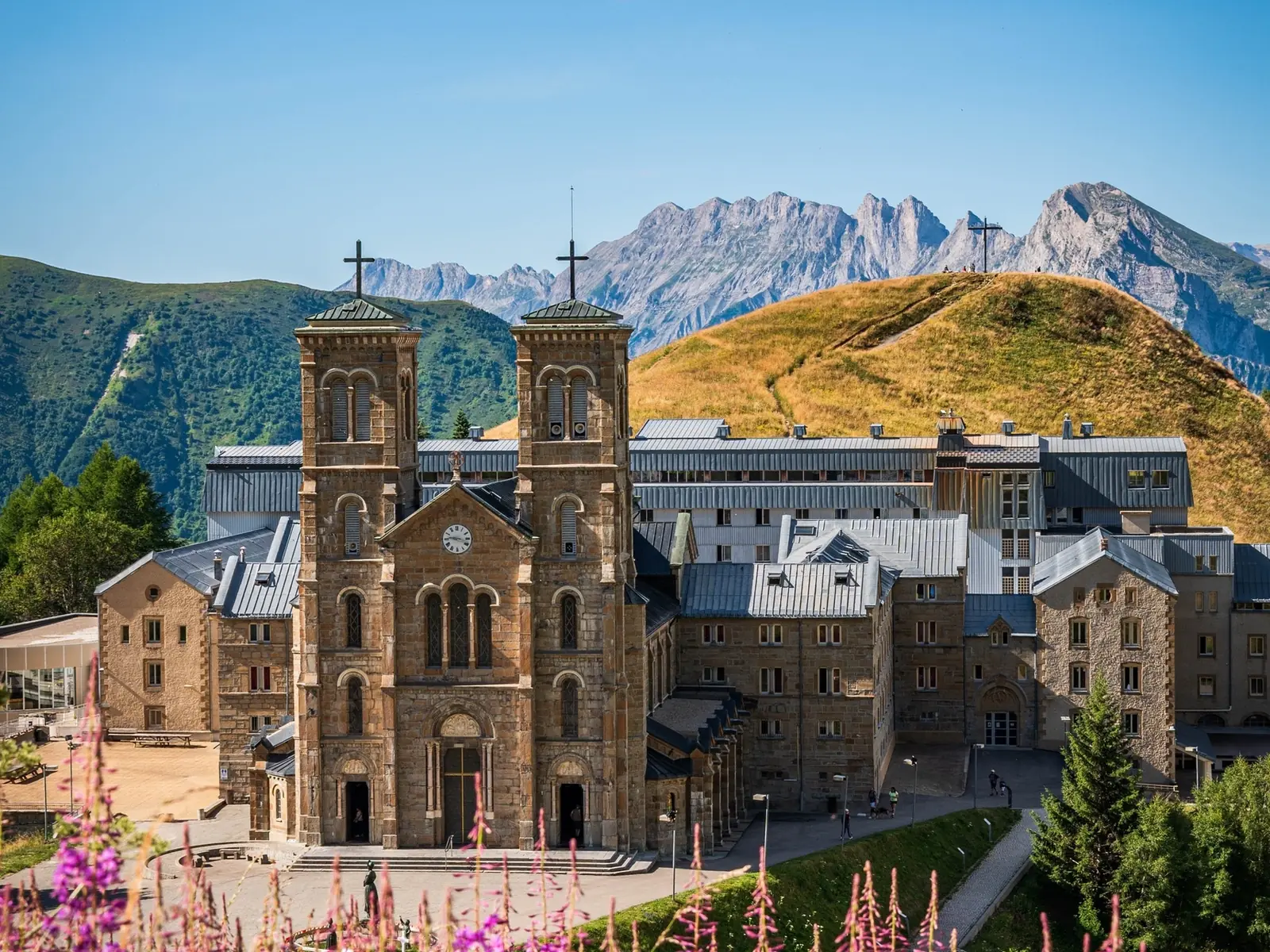
The shrine stands on the mountain where the children saw the Lady, at about 5,900 feet, some 2,200 feet above the village of La Salette-Fallavaux, and the road climbs to it from Corps. At the place of the apparition, bronze statues mark the stages of the meeting. The basilica stands close by; begun in 1852 and consecrated in 1879, it contains the crowned statue of Our Lady. The anniversary on September 19, 2026, marked 180 years since the apparition.
Conditions are those of the high Alps. Nights are cold even in summer, and the weather can change within an hour. In winter snow covers the mountain, and the road and the shrine’s services may be limited, so ask the shrine about access before planning a visit between late fall and spring. Bring warm layers and rain gear in every season. Altitude makes walking harder, so climb slowly and drink water, and pilgrims with heart or lung conditions should consult a doctor before the trip.
A day trip from Grenoble is possible, but a night on the mountain gives time to pray at the place of the apparition in the evening and early morning, when the day visitors have gone. The shrine has rooms for pilgrims, which should be booked well ahead, and walkers will find footpaths on the slopes around it; use them only in good weather and with proper boots. La Salette is a stop on Via Immaculatae, between Nevers and Le Laus. Older pilgrims should read our notes on pilgrimages at a gentle pace and on practical matters before choosing a mountain itinerary.
Further reading: Nevers: Saint Bernadette at the Convent of Saint-Gildard; Lourdes: A Pilgrim’s Guide to the Grotto of Massabielle; Marian Apparitions of France: A Pilgrim’s Guide.
To see and to pray
- The place of the apparitionBronze statues mark the stages of the Lady’s meeting with the children.
- The basilicaBegun in 1852 and consecrated in 1879.
When to go
The shrine is open all year, and its guest house receives pilgrims in every season. The full season opens with a Mass on March 19 and runs into the fall, and April to October is the busiest time. In winter the road from Corps requires a properly equipped vehicle.
The great days are the novena from September 10 to 18, with torchlight processions, and September 19, the anniversary of the apparition; 2026 marked its 180th anniversary.
Mass and prayer
The Missionaries of Our Lady of La Salette, fathers, brothers and sisters, keep the shrine. From March 19 to September 19 Mass is celebrated three times a day, twice a day in the fall and once in winter. No liturgy in English is published, though English is among the languages spoken at the guest house.
Walking and access
The shrine stands at about 5,900 feet, where the air is thinner and the weather changes quickly, even in summer. Ramps and elevators give access to every part of the shrine, and the guest house is accessible to wheelchair users. Pilgrims with heart or breathing problems should ask their doctor before coming, and everyone should bring warm clothes and walking shoes.
Feast
- September 19Anniversary of the apparition
On our way
Getting there
About an hour and a half by road from Grenoble; from Corps the road climbs about nine miles to the shrine.
The shrine’s own website, for times and news: lasalette.cef.fr/en
Questions
Can we stay overnight at La Salette?
Yes. The guest house is open all year, with rooms and meals; group pilgrimages usually stay two nights.
Is La Salette open in winter?
Yes, with one Mass a day and shorter reception hours. The mountain road requires winter equipment.
How do we get to La Salette?
From Grenoble, about an hour and a half by road. Buses run from Grenoble to Corps, and up to the shrine in July and August; taxis serve the last nine miles from Corps.