The holy places of France · Burgundy-Franche-Comté
Nevers The Convent of Saint-Gildard
Nièvre, Burgundy-Franche-Comté
- Feast
- April 16
- Getting there
- About two hours by train from the Gare de Bercy in Paris.
- On our ways
- Via Gratiae, Via Immaculatae, Via Sanctorum
From Lourdes to Saint-Gildard
The Sisters of Charity of Nevers had known Bernadette Soubirous since the year of the apparitions. They ran the hospice of Lourdes, where she went to school from January 1858, made her First Communion that June and lived from 1860 to 1866. The congregation dates its foundation to 1680 and to Jean-Baptiste Delaveyne, a Benedictine who called the young women of his native village, Saint-Saulge, in the Nièvre, to give themselves to works of charity. In 1853 Bishop Dominique-Augustin Dufêtre of Nevers gave the sisters the site of the old church of Saint-Gildard, and their new mother house was consecrated on July 15, 1856. Its façade bears the words Deus Charitas Est, God is love.
Bernadette left Lourdes on July 4, 1866, and reached Saint-Gildard on the evening of July 7, with the superior from Lourdes and two other young women. The next day, in her Pyrenean costume, she told the story of the apparitions for the last time, to about 300 sisters gathered in the novitiate room, now the novitiate chapel. On July 29 she received the habit with 42 other candidates and the name Sister Marie-Bernard, after her godmother and aunt, Bernarde Casterot. Her whole life is told on our page on Saint Bernadette, and the eighteen apparitions in our guide to Lourdes.
Sister Marie-Bernard
Her novice mistress, Mother Marie-Thérèse Vauzou, was severe with her and suspected her of vanity, and Bernadette bore it with humility. She worked first in the kitchen. Her gentle manner with the sick then brought her to the infirmary, as assistant nurse and later head nurse, and finally she served as sacristan, embroidering altar cloths and vestments. She made her first profession on October 30, 1867, with 44 novices, and her perpetual vows in September 1878.
She was often ill. Cholera in childhood had left her with chronic asthma, and she later suffered from tuberculosis of the lungs and bones and from a tumor on the knee. In her last two years the pain was severe, and she spent long periods in the infirmary. She said of herself, “I am ground like a grain of wheat.” She died in the infirmary on Wednesday of Easter week, April 16, 1879, aged thirty-five, in the room that is now the Holy Cross Oratory. Her last words, as recorded, were a prayer: “Blessed Mary, Mother of God, pray for me! A poor sinner, a poor sinner.” She was buried in the Saint Joseph chapel, built in 1860 in the convent garden.
The examinations of her body
As her cause for beatification advanced, her body was examined three times. On September 22, 1909, the coffin was opened in the presence of Bishop Gauthey of Nevers, the church tribunal, the mayor, witnesses and two doctors, Jourdan and David. They found the body well preserved and without odor, the face a dull white and the hands intact. It was washed, reclothed and placed in a new double coffin. Bernadette was declared Venerable in August 1913. A second examination, on April 3, 1919, by Doctors Talon and Comte, agreed with the first and described the body as practically mummified.
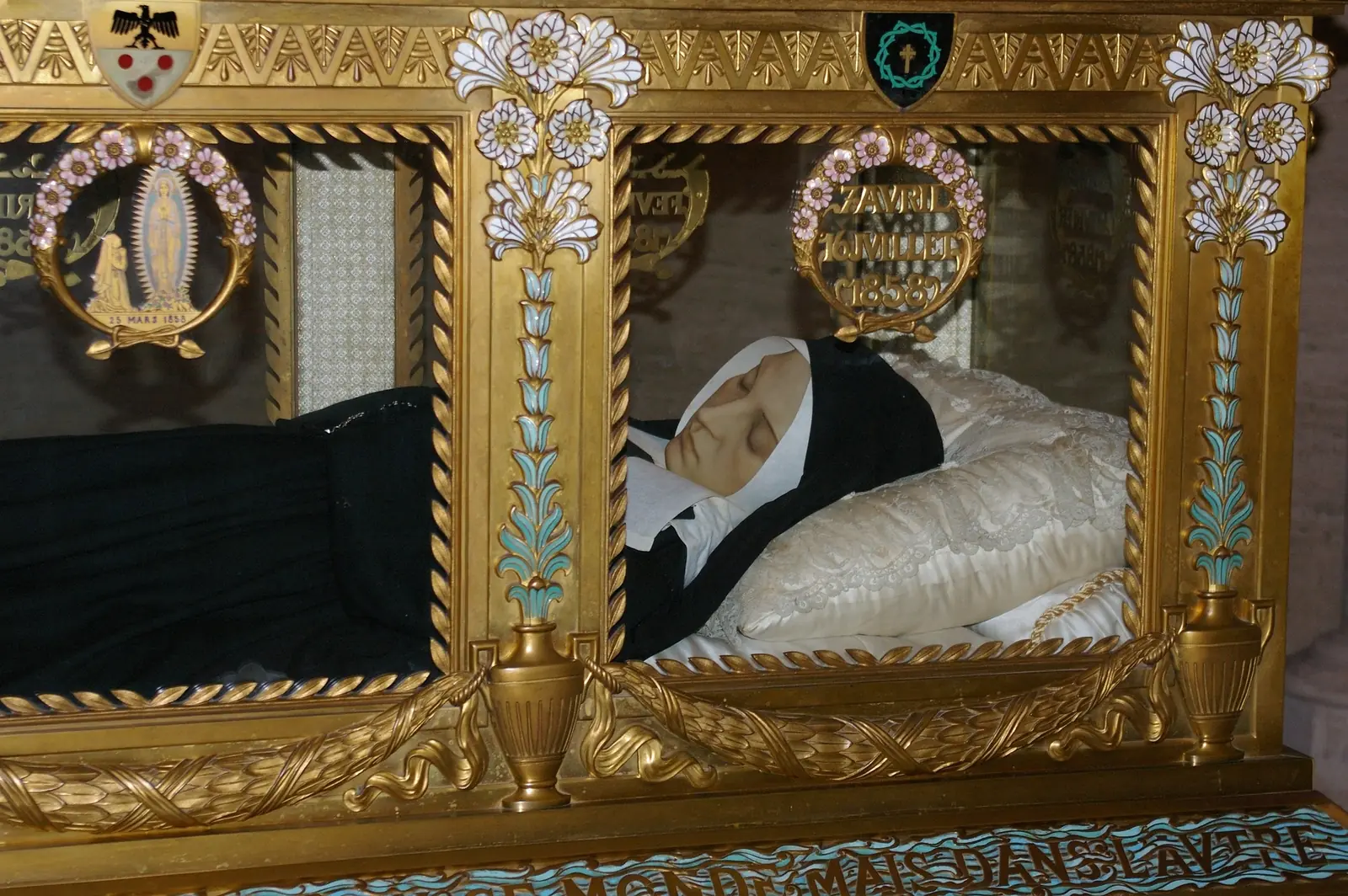
The third examination, on April 18, 1925, was held privately. Dr. Comte found the skeleton complete and the muscles atrophied but preserved, and he removed relics, among them parts of two ribs and both kneecaps; some were sent to Rome. Because the skin of the face had darkened and the features had sunk, the Paris firm of Pierre Imans made light wax masks for the face and hands from molds and photographs, and they were put in place in July 1925. On the evening of August 3, 1925, her reliquary of glass and bronze was carried from the novices’ hall into the convent chapel, where it has remained.
Pius XI beatified her on June 14, 1925, and canonized her on December 8, 1933, the feast of the Immaculate Conception. Her feast is kept on April 16, the day of her death, and in France on February 18.
The Espace Bernadette
The former mother house, now the Espace Bernadette Soubirous, has been run as a sanctuary since 1970 by volunteers and a few sisters. The center of the visit is the chapel, built on the ruins of the abbey of Saint-Gildard and consecrated in 1856. Bernadette’s reliquary lies to the right of the main altar, and pilgrims pray before it through the day. Keep silence in the chapel, and check the sanctuary’s website, sainte-bernadette-soubirous-nevers.com, for Mass times.
The museum, opened by the sisters in 1958, follows her life from Lourdes to Nevers with photographs and objects from her daily life. In the house you can also see the novitiate chapel, where she gave her last account of the apparitions, and the Holy Cross Oratory, the former infirmary room where she died. The gardens cover about ten acres. In them are the Saint Joseph chapel, open to the public, where she lay from 1879 to 1925, and a statue of Our Lady of the Waters, Notre-Dame des Eaux, before which she often prayed. A replica of the grotto of Massabielle, built in 1884 at the request of Mother Vauzou, contains a piece of the rock from Lourdes, and pilgrims light candles there. The house also has a cloister, a shop and meeting rooms.
The sanctuary also lodges pilgrims. The sisters’ former cells are now guest rooms for up to 200 people, and meals are served every day.
The city and its cathedral
Nevers stands on the Loire and is the seat of a diocese. It belongs to the Villes Sanctuaires, the association of French towns that receive pilgrims at their shrines. The Espace Bernadette is a few hundred yards from the train station, the Ducal Palace and the cathedral, so the whole visit can be made on foot. The Cathedral of Saint-Cyr-et-Sainte-Julitte is dedicated to Saint Cyr and his mother, Saint Julitta, who according to tradition were martyred together in the early Church. It has two apses facing each other, a Romanesque apse at one end and a Gothic choir at the other. Its windows are modern work by several contemporary artists, among them Jean-Michel Alberola. The Ducal Palace nearby, begun in the 1460s, has a long Renaissance façade.
Planning a visit
Nevers is a stop on three of our itineraries: Via Gratiae, between Chartres and Paray-le-Monial; Via Immaculatae, between Pellevoisin and La Salette; and Via Sanctorum, between Tours and Paray-le-Monial. Allow at least half a day for the chapel, the museum, the gardens and the walk to the cathedral, and more if you want time for prayer before the reliquary. The address of the Espace Bernadette is 34 rue Saint-Gildard, and groups arriving by train can walk there from the station.
April 16, 2029, will mark 150 years since Bernadette’s death, and December 8, 2033, a century since her canonization. Mass times, opening hours and room bookings are on the sanctuary’s website, and train travel from Paris is covered in our practical matters.
Further reading: La Salette: The Apparition of 1846 and the Alpine Shrine; Lourdes: A Pilgrim’s Guide to the Grotto of Massabielle; Marian Apparitions of France: A Pilgrim’s Guide.
To see and to pray
- The chapel of Saint-GildardSaint Bernadette’s shrine.
- The museumHer life in Lourdes and in Nevers, with some of her belongings.
- The cathedral of Saint-Cyr-et-Sainte-JulitteWith a Romanesque apse at one end and a Gothic choir at the other.
When to go
The shrine is open every day of the year, and the chapel where Bernadette’s body rests opens in the morning and the afternoon. Its feasts are February 18, Bernadette’s feast in France, and April 16, the anniversary of her death in 1879.
Mass and prayer
Mass is celebrated each day in the chapel, in the late morning (at 10 a.m. on Sunday), and the Sisters of Charity of Nevers pray evening prayer at 6:30 p.m. There is no regular Mass in English, but a group that brings its own priest can celebrate Mass in English by booking ahead. The audio guide is available in several languages.
Walking and access
The shrine is about six hundred yards from the station and has its own parking. Mass in the chapel is wheelchair accessible; the shrine publishes no further details. The convent grounds also hold a replica of the grotto of Lourdes and some ten acres of gardens.
Feast
- April 16; February 18 in FranceFeast of Saint Bernadette Soubirous
The saint of this place
- Saint Bernadette SoubirousThe seer of Lourdes
On our ways
Getting there
About two hours by train from the Gare de Bercy in Paris.
The shrine’s own website, for times and news: sainte-bernadette-soubirous-nevers.com/en
Questions
How long should we stay at Nevers?
Half a day for the chapel, the museum and the gardens. Groups who follow the shrine’s program in Bernadette’s steps stay one or two days, and the shrine has rooms for pilgrims.
Can we see the body of Saint Bernadette?
Yes. It lies in a glass reliquary in the chapel of the convent; since 1925 a thin wax mask has covered her face and hands.
How do we get to Nevers?
By direct train from the Gare de Bercy in Paris, in about two hours.
Sources
- The sanctuary, Sanctuaire Sainte-Bernadette de Nevers
- The Body of St. Bernadette of Lourdes, EWTN
- Saint Bernadette Soubirous, Virgin, Patroness of Lourdes, EWTN
- St. Bernadette of Lourdes, Encyclopaedia Britannica
- Bernadette à Nevers (1866-1879), Étoile Notre-Dame
- Nevers (France): Saint Bernadette’s Crystal Coffin, Marie de Nazareth Marian Encyclopedia
- Walking in Bernadette’s footsteps, Sanctuary of Our Lady of Lourdes
- Sainte Bernadette Soubirous, Nevers Tourisme (tourist office)
- Espace Bernadette Soubirous Nevers, Wikipedia
Facts checked against these sources on .
Nearby
- SouvignyThe Priory of Saint-Pierre-et-Saint-Paul, about 32 miles as the crow flies
- VézelayThe Basilica of Sainte-Marie-Madeleine, about 43 miles as the crow flies
- AutunThe Cathedral of Saint-Lazare, about 54 miles as the crow flies
- Paray-le-MonialThe Shrine of the Sacred Heart, about 59 miles as the crow flies