The holy places of France · Burgundy-Franche-Comté
Vézelay The Basilica of Sainte-Marie-Madeleine
Yonne, Burgundy-Franche-Comté
- Feasts
- July 22, August 20
- Getting there
- About two and a half hours by road from Paris.
- On our way
- Via Benedicti
The abbey and Mary Magdalene
Count Girart de Roussillon and his wife Berthe founded a monastery in 858 or 859 at Saint-Père, at the foot of the hill of Vézelay. A bull of Pope Nicholas I in 863 placed it under the direct protection of the Holy See, and Charles the Bald confirmed its privileges in 868. After Norman raiders sacked Saint-Père in 873, the monks moved up the hill, where Pope John VIII consecrated their first church in 878.
The abbey was dedicated at first to the Virgin Mary. According to its own tradition, in 882 a monk named Badilo was sent to Saint-Maximin in Provence, then troubled by Saracen raids, and brought back relics of Mary Magdalene. The cult grew under Abbot Geoffroy, who ruled from 1037 to 1052, displayed the relics and made known the miracles reported at Vézelay. In 1050 the patronage of the abbey passed to Mary Magdalene, and in 1058 Pope Stephen IX solemnly recognized the relics and placed the abbey under Abbot Hugh of Cluny. Crowds of pilgrims climbed the hill, and the church was consecrated in 1104.
Saint-Maximin and the long decline
In 1279 a tomb was opened at Saint-Maximin, in Provence, and declared to hold the body of the saint, and Pope Boniface VIII later took the side of Saint-Maximin. Pilgrims gradually went south instead, and in 1458 Pope Pius II noted that they had abandoned Vézelay. Our Via Magdalenae visits Saint-Maximin and the grotto of La Sainte-Baume, where Provençal tradition places the last years of the saint.
In the sixteenth century the abbey was secularized and a chapter of canons replaced the monks. Its abbot Odet de Coligny converted to Calvinism in 1561, and Huguenot soldiers, then royal troops, occupied the abbey in 1568 and 1569. During the Revolution the abbey buildings were sold and used as a quarry, and little survives apart from the chapter house. In 1793 a mason beheaded and mutilated the portal statues and hammered the old tympana smooth. In the nineteenth century an archbishop of Sens, Victor-Félix Bernadou, returned to Vézelay relics of Mary Magdalene that had been kept in the treasury of Sens since 1281, and in 1920 the church was given the rank of basilica.
Saint Bernard, the crusades and Compostela
On Easter Day 1146 Saint Bernard of Clairvaux preached the Second Crusade at Vézelay before King Louis VII. The crowd was too large for the church, and a platform was built on the north slope of the hill, outside the town. According to tradition, so many asked for the cross that Bernard tore his own habit into strips to make more. A church was later built to mark the place.
In early July 1190, the kings of France and England met at Vézelay with their armies before leaving on the Third Crusade. Saint Louis came in 1248, before his own crusade, and later attended a solemn translation of the relics, for which he gave two reliquaries. Vézelay was also one of the great starting points of the medieval pilgrimage to Santiago de Compostela, and pilgrims bound for Spain set out from the basilica.
The climb and the narthex
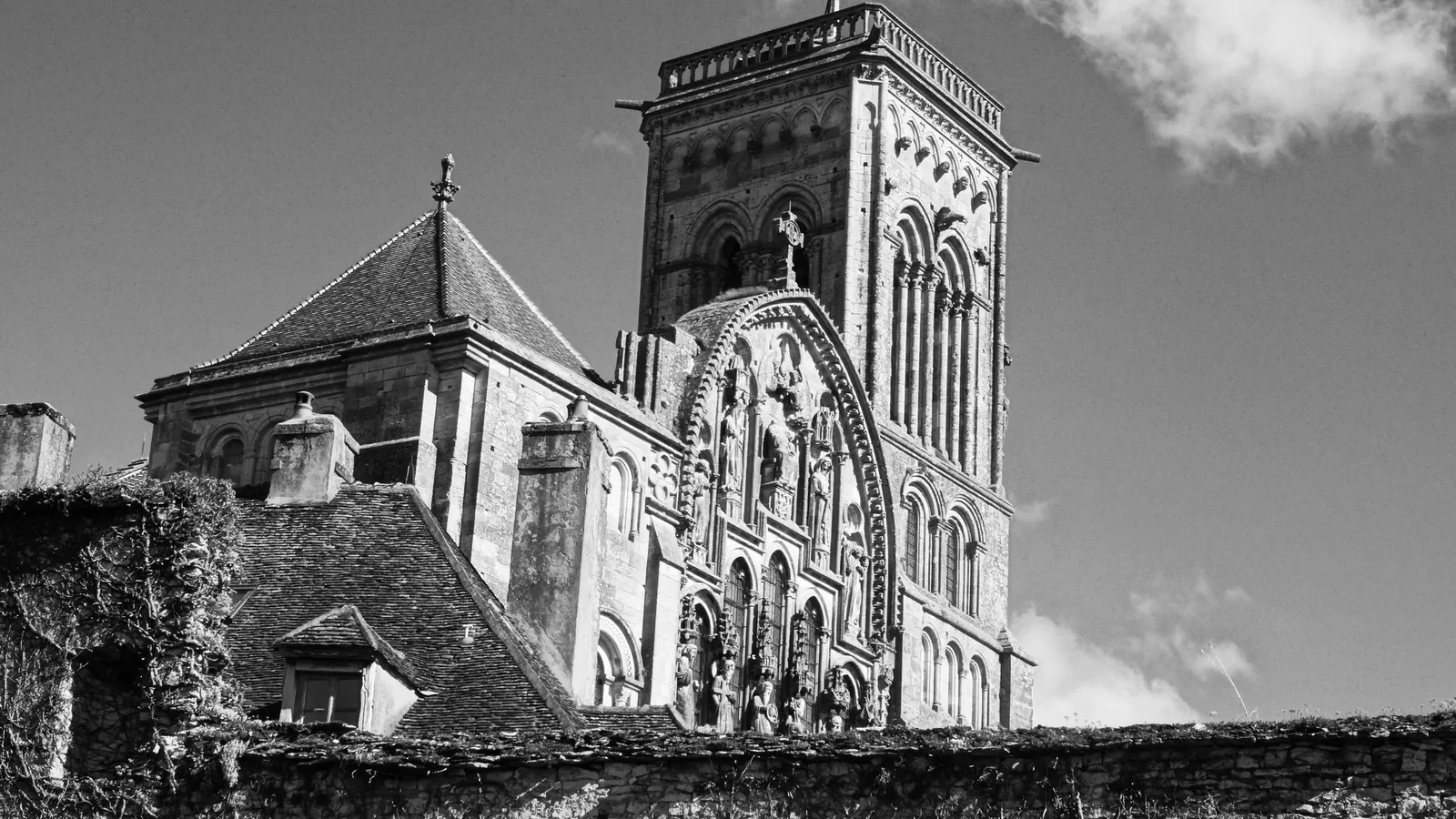
Vézelay is a small town of fewer than five hundred people, and its main street climbs steadily up the hill to the basilica at the top. The west front was heavily remodeled in the nineteenth century. Its great gable, added in the thirteenth century, shows Christ seated between the Virgin and Mary Magdalene, and the tower of Saint-Michel on the right, of the fourteenth century, stands about 125 feet high. The Last Judgment over the central door was carved in 1856 by Michel-Pascal under the direction of Viollet-le-Duc, and the original, defaced in 1793, was moved to the outer wall of the south side of the nave.
The doors open into the narthex, a vaulted entrance church built between about 1135 and 1145. Over its central door is the great tympanum, carved around 1130. Christ sits in glory among the apostles, and the scene joins his Ascension to the gift of the Holy Spirit at Pentecost and to the sending of the apostles to teach all nations, the command with which Saint Matthew’s Gospel ends. In eight compartments above the apostles are peoples of Asia. On the lintel, peoples of Europe on one side and of Africa on the other move toward Christ, led by Saint Peter and Saint Paul. In the arch around the tympanum, signs of the zodiac alternate with the labors of the months.
The nave, the capitals and the light
A fire broke out on the eve of the feast of Mary Magdalene in 1120, and the Chronicle of Saint-Maixent records 1,127 dead. The nave was rebuilt in the following years and finished by about 1140. It is about 205 feet long and 61 feet high under the vaults, with ten bays, and its transverse arches are built of alternating pale and dark stones, which give the nave its striped look. The nave has no stained glass.
The church has 118 carved capitals, 94 in the nave and 24 in the narthex, made between about 1125 and 1140, probably by a workshop of five sculptors. Eight were recarved in the nineteenth century. They show Bible stories, moral lessons and a few scenes from pagan myth. The best known, the Mystic Mill, shows Moses and Saint Paul at a mill, and nearby is the Abduction of Ganymede. Binoculars help with the higher capitals.
In 1976 a Franciscan friar serving the basilica, Hugues Delautre, noticed that at solar noon on the summer solstice the sunlight from the south windows falls in a line of bright patches along the middle of the nave. The orientation and the proportions of the church account for it, and the effect can be seen around midday in the days around the solstice.
The choir, the crypt and Viollet-le-Duc
Beyond the nave rises the Gothic choir, begun about 1185 under Abbot Girard d’Arcy and completed, with the transept, by Abbot Gautier between 1207 and 1216. It stands about 72 feet high, taller than the nave, and is known for its brightness. Beneath it lies the crypt. Its western part is Romanesque and usually attributed to Abbot Artaud, at the end of the eleventh century, and the eastern part was built under Abbot Gautier. The relics of Mary Magdalene are venerated in the crypt, and her feast is kept on July 22.
In February 1840 Prosper Mérimée, inspector of historic monuments, entrusted the rescue of the church to Eugène Viollet-le-Duc, then about 26 years old. When Mérimée inspected the building, he had heard stones falling around him. The work lasted nineteen years. Viollet-le-Duc lightened the roof, built new arches to hold the structure and slightly changed the shape of some vaults and arches. Critics attacked these changes in the 1960s, and his defenders answered that without them the roof would have collapsed under its own weight. The basilica and the hill were inscribed on UNESCO’s World Heritage List in 1979.
The community and La Cordelle
Since 1993 the Monastic Fraternities of Jerusalem, brothers and sisters, have kept the prayer of the basilica, and they still do so in 2026. They sing Lauds, Mass and Vespers every day except Monday, when only Mass is celebrated, keep adoration of the Blessed Sacrament on Thursdays and Saturdays, lead visits, and run two guest houses and a monastic shop. The basilica belongs to the diocese of Sens-Auxerre and to the parish of Saint-François du Vézelien.
The Franciscans first came to Vézelay much earlier. In 1217, during the lifetime of Saint Francis, the first Franciscan house in France was founded on the northeast slope of the hill, at the chapel of La Cordelle, on the site that tradition links with the preaching of Saint Bernard. The Crusade for Peace of July 18 to 22, 1946, brought some 30,000 pilgrims to the hill. The times of the offices and of guided visits are posted on the basilica’s website, and Vézelay is a stop on our Via Benedicti, between Saint-Benoît-sur-Loire and Fontenay.
Further reading: Mary Magdalene in Provence: The Tradition and the Shrines; Romanesque France: Cluny and the Churches of the Pilgrim Roads.
To see and to pray
- The tympanum of the narthexChrist sending out the apostles, carved around 1130.
- The naveIts arches of alternating stone.
- The cryptWhere the relics of Mary Magdalene are venerated.
When to go
The basilica is open every day of the year, from 7 a.m. (8 a.m. on Mondays) to 8 p.m.; visits pause during Sunday Mass. Between June 20 and 30, around midday, nine patches of sunlight fall along the center of the nave.
The feast of Saint Mary Magdalene, July 22, is kept with Vigils on the evening before, a procession and a solemn Mass. From All Saints to Easter the town is quiet, and guided tours must be booked.
Mass and prayer
The Monastic Fraternities of Jerusalem, brothers and sisters, sing Lauds, Mass and Vespers in the basilica, with Mass at 12:15 p.m. on weekdays and at 11 a.m. on Sunday, and keep adoration on Thursday and Saturday afternoons. A priest is available on Saturdays. Nothing is offered in English, but groups may book a guided visit in English.
Walking and access
The town is built on a hill, and its main street rises steadily to the basilica. Cars may stop near the square in front of the basilica to let passengers out. The guest houses of the Fraternities, open almost all year, list access for pilgrims with reduced mobility.
Feasts
- July 22Feast of Saint Mary Magdalene
- August 20Feast of Saint Bernard of Clairvaux
The saints of this place
- Saint Mary MagdaleneDisciple of Christ and first witness of the Resurrection
- Saint Bernard of ClairvauxAbbot of Clairvaux and Doctor of the Church
On our way
Getting there
About two and a half hours by road from Paris.
The shrine’s own website, for times and news: basiliquedevezelay.org
Questions
Is the basilica free?
Yes. The afternoon guided tour in season costs about €6, and groups of ten or more book in advance.
How long should we stay in Vézelay?
Half a day for the basilica and the climb up the hill. A night lets you attend Vespers and Lauds with the community.
How do we get to Vézelay?
By train from the Gare de Bercy in Paris to Sermizelles-Vézelay, in about two and a half hours, then six miles by shuttle or taxi. By road it is two to two and a half hours from Paris.