The holy places of France · Occitanie
Lourdes The Sanctuary of Our Lady of Lourdes
Hautes-Pyrénées, Occitanie
- Feasts
- April 16, February 11
- Getting there
- Under five hours from Paris by direct high-speed train, or about an hour and a half by air to Tarbes-Lourdes airport.
- On our ways
- Via Gratiae, Via Immaculatae
The eighteen apparitions
On Thursday, February 11, 1858, Bernadette Soubirous, fourteen, went to gather wood beside the Gave with her sister Toinette and a friend, Jeanne Abadie. She was the eldest child of a miller whose family had fallen into poverty and lived in one room of the old town jail. At the rock of Massabielle she heard a sound like a gust of wind and saw, in a hollow of the rock, a lady dressed in white, with a yellow rose on each foot. On February 14 Bernadette sprinkled holy water toward her, and the lady smiled and bowed her head.
On February 18 the lady spoke for the first time. In the words the sanctuary gives from Bernadette’s account, she asked, “Would you do me the honor of coming here for fifteen days?” and said, “I don’t promise to make you happy in this world, but in the other.” On February 19 Bernadette brought a blessed candle, the origin of the candles at the grotto. On February 24 the lady asked for penance and prayer for sinners. On February 25 she told Bernadette to drink at the spring and wash in it; Bernadette scraped the ground, found muddy water and drank, and the spring she uncovered still flows. On February 28 over a thousand people watched her in ecstasy. On March 1 Catherine Latapie, from the village of Loubajac, dipped her paralyzed arm in the spring and recovered its use, the first cure of Lourdes.
On March 2 the lady asked Bernadette to tell the priests that people should come in procession and that a chapel should be built. The parish priest, Father Dominique Peyramale, wanted her name first. On March 4, the last of the fifteen days, some 8,000 people waited, and the vision was silent. On March 25, the feast of the Annunciation, the lady gave her name in Occitan, “Que soy era Immaculada Councepciou,” “I am the Immaculate Conception.” Bernadette did not know what the words meant and repeated them to Peyramale, who knew that Pius IX had defined the dogma in 1854. On April 7 the flame of her candle licked her hands without burning them, as Dr. Dozous observed. On July 16, the feast of Our Lady of Mount Carmel, with the grotto barricaded, she saw the Virgin from the meadow across the river for the eighteenth and last time.
Bernadette, the bishop and the doctors
Bernadette made her First Communion on June 3, 1858, in the chapel of the hospice kept by the Sisters of Nevers, and from 1860 she lived there. The crypt, the first church built above the grotto, opened in May 1866. On July 4, 1866, she left Lourdes for the sisters’ mother house at Nevers, where she died as Sister Marie-Bernard on April 16, 1879. Pius XI canonized her on December 8, 1933; see our page on Saint Bernadette.
Bishop Bertrand-Sévère Laurence of Tarbes opened an inquiry in 1858. On January 18, 1862, in a pastoral letter, he judged that the Immaculate Mary, Mother of God, had appeared to Bernadette eighteen times, authorized her cult at the grotto and asked for a sanctuary to be built.
The Medical Bureau, founded in 1883, examines reported cures. When a case holds up, often after years of study, the International Medical Committee of Lourdes votes on whether the cure is unexplained in the present state of medical knowledge, and the bishop of the person’s home diocese decides whether to declare a miracle. More than 7,000 cures have been recorded, and 72 have been recognized as miracles. The latest, proclaimed on April 16, 2025, is the cure of Antonia Raco, an Italian woman healed of primary lateral sclerosis on a pilgrimage in 2009.
The grotto, the spring and the baths
In the niche where the Virgin stood is a statue by Joseph-Hugues Fabisch, dating from 1864. Pilgrims pass beneath the rock, touching it as they go, and light candles nearby. The spring at the foot of the grotto feeds eighteen drinking fountains, one for each apparition, and taps where pilgrims fill bottles to take home. The water is free and may not be sold, and the sanctuary notes that scientific analyses have found no special property in it.
At the baths, volunteers of the Hospitalité Notre-Dame de Lourdes receive the pilgrims. Immersion in the cold water was suspended in 2020 and replaced by the “water gesture,” in which pilgrims drink from the spring and wash face, hands and forearms. Immersion resumed in stages from August 2024. Men and women are received separately, and no bathing suit is needed. The current arrangements and hours are posted on the sanctuary’s website.
The basilicas and the Way of the Cross
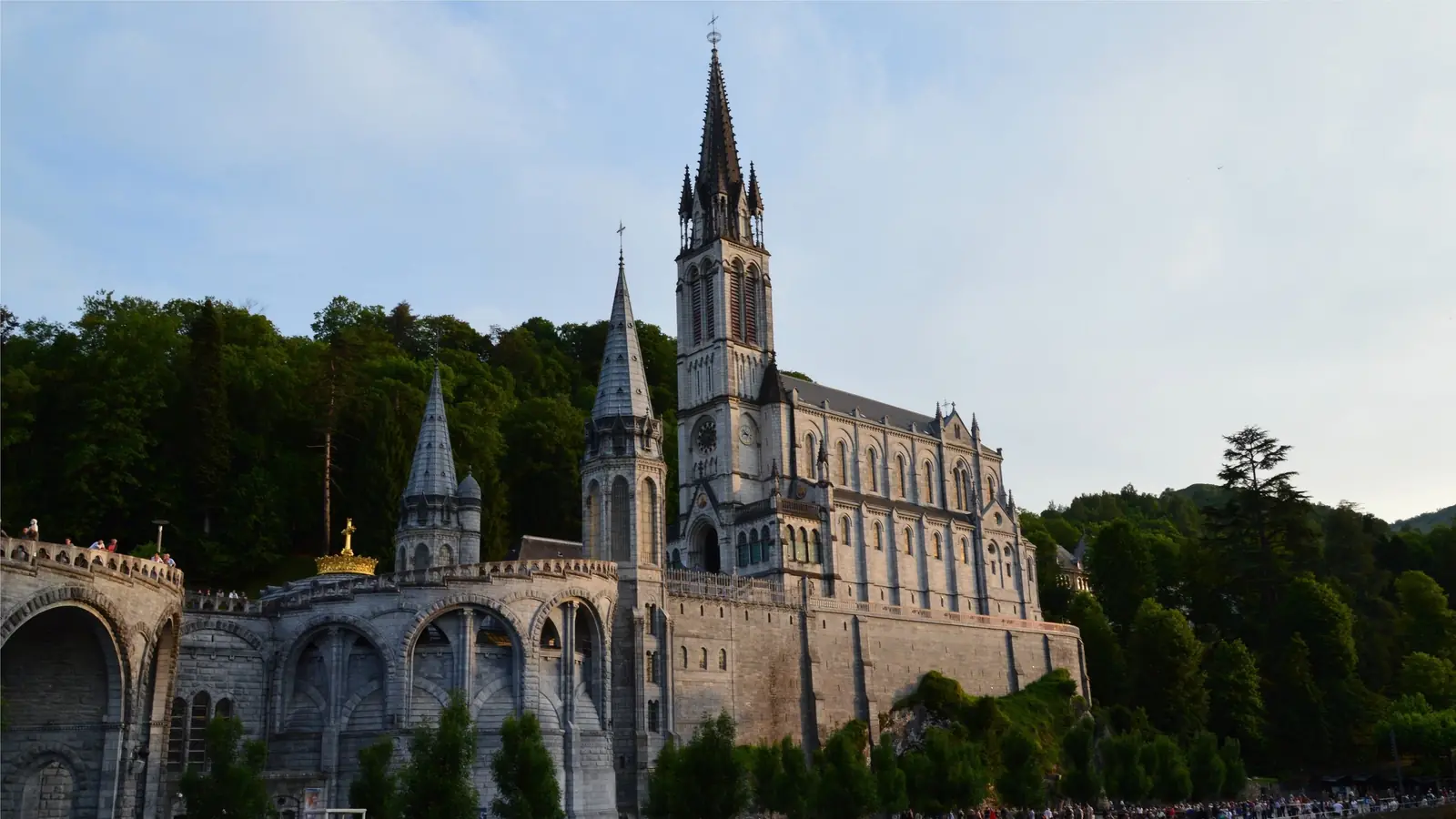
Three churches stand together against the rock of Massabielle. The crypt, opened in May 1866, was the first. Above it stands the neo-Gothic Basilica of the Immaculate Conception by Hippolyte Durand, consecrated on July 1, 1876, with a spire 230 feet high and 42 windows depicting the apparitions and the history of Lourdes. Below them is the Rosary Basilica by Léopold Hardy, consecrated in 1901, with some 21,500 square feet of mosaics of the mysteries of the Rosary.
The underground Basilica of Saint Pius X, built of prestressed concrete for the centennial of the apparitions, was consecrated on March 25, 1958, by Cardinal Angelo Roncalli, the future John XXIII. It is about 660 feet long and holds some 20,000 people. The international Masses are celebrated there, and the Eucharistic procession ends there with adoration and the blessing of the sick.
The Way of the Cross, opened in 1912, climbs the wooded hill of the Espélugues for nearly a mile, with 115 life-size cast-iron figures at fifteen stations. The path is steep and not accessible to wheelchairs, and the sanctuary plans to begin restoring the figures in 2026. A second Way of the Cross on the meadow by the river, with seventeen stations of Carrara marble, opened in 2008 and is accessible to pilgrims with reduced mobility.
Bernadette’s town
The places of Bernadette’s childhood are a short walk from the sanctuary. She was born on January 7, 1844, at the Boly mill, where the room of her birth, the kitchen and the millstones can be seen. From the winter of 1857 to the fall of 1858 the family lived in the cachot, a former jail, in one dark room of about 170 square feet, and Bernadette set out from it for the grotto on February 11. The parish church contains the font where she was baptized on January 9, 1844, and the tomb of Father Peyramale. A Bernadette trail, marked by studs set in the street, links these places with the old presbytery and the former hospice of the Sisters of Nevers, where she lived from 1860 to 1866.
Processions, the sick and the hospitaliers
The lady asked for processions, and from April to October there are two each day. The torchlight procession, begun in 1863 by a Capuchin, Father Marie-Antoine, who had organized one at Rocamadour a few months before, sets out from the grotto each evening behind a cross, with the sick ahead of the statue of Our Lady. Pilgrims raise their candles at the refrain of the Lourdes Ave Maria. In 2026 France entered the procession in its inventory of intangible cultural heritage. The Eucharistic procession sets out from the meadow in the afternoon and ends in the Basilica of Saint Pius X, where the sick in the front rows receive the blessing with the Blessed Sacrament.
Pius XII wrote in his encyclical Le Pèlerinage de Lourdes, in 1957, that “nowhere, perhaps, except at Lourdes does one feel so moved to prayer, to the forgetting of oneself, and to charity.” In 2024, about 410,000 people came to Lourdes in organized pilgrimage groups, many of them bringing the sick. Sick pilgrims who need care stay at the Accueil Notre-Dame, inside the sanctuary, or at the Accueil Marie Saint-Frai. Their care falls largely to the Hospitalité Notre-Dame de Lourdes, founded in 1885, whose volunteers, the hospitaliers, serve in turns through the year, at the station and the airport, in the ceremonies and at the baths. The three associations of the Order of Malta in the United States come in the same week with their sick pilgrims.
Practical advice for a first visit
Allow at least two full days. Mass times, the languages of the celebrations and the hours of the baths vary with the season and are posted on the sanctuary’s website, lourdes-france.org. The sanctuary is fullest around August 15, during the French national pilgrimage of the Assumption. Wear sturdy shoes for the Espélugues, and bring a rain jacket and an empty bottle for the water.
Lourdes has its own train station, and Tarbes-Lourdes-Pyrénées airport serves the region; see practical matters. Older pilgrims may prefer our pilgrimages at a gentle pace, and parishes will find advice for group leaders. Lourdes is the last stop of Via Gratiae and of Via Immaculatae.
Further reading: Nevers: Saint Bernadette at the Convent of Saint-Gildard; La Salette: The Apparition of 1846 and the Alpine Shrine; Rocamadour: A Pilgrim’s Guide to Our Lady of Rocamadour.
To see and to pray
- The grotto of MassabielleWhere the Virgin appeared, and the spring.
- The bathsWhere pilgrims receive the water of the spring.
- Bernadette’s townThe cachot where her family lived in 1858, and the mill where she was born.
When to go
The sanctuary is open all year, but its season of pilgrimages runs from Easter to the end of October, when the daily processions take place and most diocesan pilgrimages come. In winter the grotto can still be reached at any hour, and a torchlight rosary replaces the procession; the sanctuary’s website gives the current hours of its gates and churches.
The great days are February 11, the feast of Our Lady of Lourdes and World Day of the Sick, and December 8, the Immaculate Conception, when the torchlight procession is held in winter as well. The National Pilgrimage fills the town in mid-August; May, June and September are calmer.
Mass and prayer
In season, the Eucharistic procession with the blessing of the sick sets out at 5 p.m. and the torchlight procession at 9 p.m. An international Mass is celebrated on Sundays and Wednesdays in the underground basilica of Saint Pius X, and a Mass in English is offered each day; its chapel varies, so ask at the information center.
From April to October, volunteers at the baths receive individual pilgrims in the morning (and on Sunday afternoon too); weekday afternoons are kept for groups who book ahead. Come early, and ask at the sanctuary how the water of the spring is offered on the day.
Walking and access
Lourdes is the most accessible of the great shrines. Ramps lead into every church, there are elevators, and wheelchairs can be borrowed at the information center. The Way of the Cross on the hill of the Espélugues is a steep climb of about a mile; a second Way of the Cross, on the meadow by the river, is level. All city buses take wheelchairs, and two lines serve the sanctuary.
Feasts
- April 16; February 18 in FranceFeast of Saint Bernadette Soubirous
- February 11Feast of Our Lady of Lourdes, and World Day of the Sick
- July 16Anniversary of the last apparition
The saint of this place
- Saint Bernadette SoubirousThe seer of Lourdes
On our ways
Getting there
Under five hours from Paris by direct high-speed train, or about an hour and a half by air to Tarbes-Lourdes airport.
The shrine’s own website, for times and news: lourdes-france.com/en
Questions
How long should we stay in Lourdes?
Two nights allow you to follow both processions, pray at the grotto at different hours and visit Bernadette’s town without hurrying. One day is enough for a first visit.
Is there Mass in English at Lourdes?
Yes. In season a Mass in English is celebrated each day, and the international Mass on Sundays and Wednesdays uses several languages. On our pilgrimages, the priest who travels with the group also celebrates Mass in English.
Do we pay to enter the sanctuary?
No. The grotto, the basilicas and the baths are free. The sanctuary suggests a small donation for its one-day pilgrim program.
How do we get to Lourdes from Paris?
By direct high-speed train in about five hours, or by air to Tarbes-Lourdes airport, about twenty minutes from the town.
Sources
- Celebrating the Apparitions of Our Lady of Lourdes to Bernadette, Sanctuary of Our Lady of Lourdes
- The recognition of the Lourdes Apparitions, Sanctuary of Our Lady of Lourdes
- The miracles of Lourdes, Sanctuary of Our Lady of Lourdes
- The water, Sanctuary of Our Lady of Lourdes
- The 3 basilicas of Lourdes, Sanctuary of Our Lady of Lourdes
- The Stations of the Cross, Sanctuary of Our Lady of Lourdes
- Walking in Bernadette’s footsteps, Sanctuary of Our Lady of Lourdes
- Christian hospitality at Lourdes, Sanctuary of Our Lady of Lourdes
- La procession mariale de Notre-Dame de Lourdes, inventory of intangible cultural heritage, French Ministry of Culture
- Lourdes and the popes, Sanctuary of Our Lady of Lourdes
- ACI Africa, Lourdes announces 72nd miracle (April 2025)
Facts checked against these sources on .