The holy places of France · Occitanie
Rocamadour The Shrine of Our Lady of Rocamadour
Lot, Occitanie
- Getting there
- About an hour by road from Brive-la-Gaillarde.
- On our way
- Via Gratiae
The legends of Saint Amadour
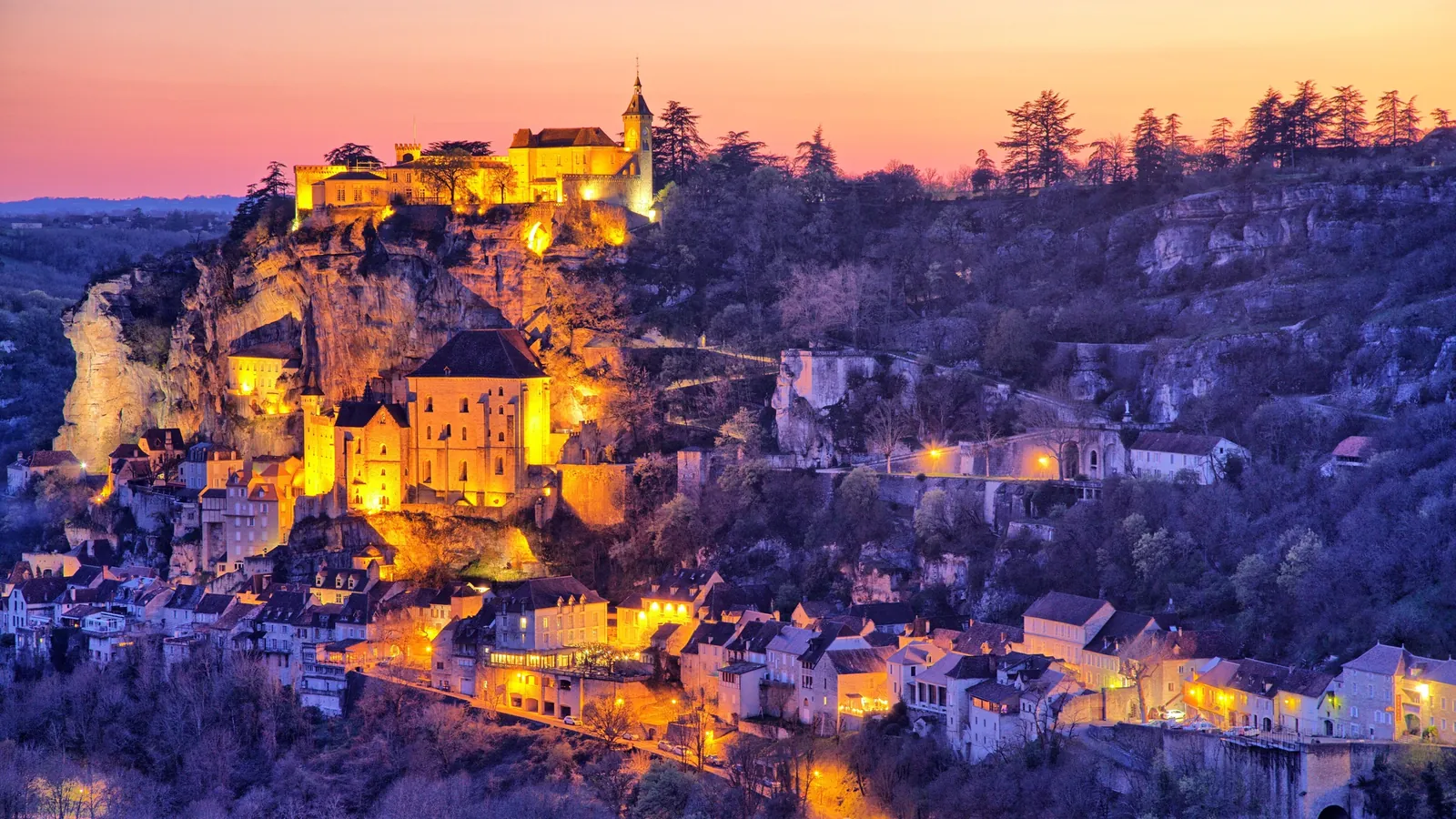
Rocamadour is a village of the Lot built against a cliff above the canyon of the Alzou, with its sanctuaries halfway up the rock. Its name is usually linked to Saint Amadour, although the Lot tourist office derives it from roca major, the greatest rock. The Catholic Encyclopedia notes that the name of Amadour appears in no document older than his Acts, which date from no earlier than the twelfth century, and his story exists in several versions.
The earliest comes from the Norman chronicler Robert of Torigni, writing around 1180, who presents Amadour as a servant of the Virgin Mary who became a hermit in Gaul. By the fifteenth century he had been identified with Zacchaeus, the tax collector of the Gospel who climbed a sycamore to see Jesus (Luke 19), and made the husband of Saint Veronica. In that telling the couple fled persecution in Palestine, landed on the coast of Aquitaine, met Saint Martial, went to Rome and saw the martyrdom of Saints Peter and Paul; after Veronica’s death Amadour returned to Quercy and built a chapel to the Virgin. Some writers made him Saint Amator, bishop of Auxerre, which the Catholic Encyclopedia calls mere hypothesis. The diocese of Cahors holds that he may have been one of the hermits who lived in the canyon in the seventh century. His feast is August 20.
The body of 1166 and the Book of Miracles
In 1166 an old tomb was opened near the entrance of the chapel of the Virgin, and a body was found in it intact. Popular devotion called him Amator, the lover of God, and the body was shown to pilgrims; Robert of Torigni records that it was on view by 1170. Protestant soldiers burned it when they sacked the sanctuary in 1562. Since 2016, the 850th anniversary of the finding of the body, what remains of the relics has been kept in a new reliquary in the church of Saint-Amadour.
Devotion to Our Lady on the rock goes back further. A papal confirmation of 1105 is the first known mention of the Marian cult, and Abbot Géraud d’Escorailles (1152 to 1188) did most to spread the pilgrimage. At his request the monks wrote down in 1172 the Book of Miracles of Our Lady of Rocamadour, which gathers 126 miracles in three books, ninety of them cures, from 1140 onward. It does not mention Amadour at all.
Kings, saints and penitents
Henry II of England came in 1159 and again in 1170. Robert of Torigni writes that the king fell gravely ill in September 1170 and, once recovered, rode south to Rocamadour to pray, with an armed escort through the lands of his enemies. His son Henry the Young King plundered the shrine in 1183 and took the silver reliquary of Saint Amadour. Alfonso of Castile and Sancho of Navarre were among the royal donors, and in 1244 Saint Louis came with his mother, Blanche of Castile.
Later lists of pilgrims add Saint Dominic and Saint Bernard of Clairvaux. A tradition says that Dominic spent a night in prayer before Our Lady of Rocamadour, but the historical notices of the shrine record neither visit, and both are best taken as tradition.
The medieval courts also sent people here for penance. A person condemned for a crime could be sentenced to go on pilgrimage to Rocamadour, to Compostela or even to Jerusalem, according to the gravity of the offense. Penitents climbed the great stairway on their knees, saying a Hail Mary on each step, and those who came in chains had them removed at the top. Two such chains still hang in the chapel of Notre-Dame.
The great stairway and the chapel of Notre-Dame
The great stairway of 216 steps climbs from the village to the sanctuaries. At the top is the square of the sanctuaries, a terrace against the cliff that served as a cemetery in the twelfth century. On it are the tomb niche of Saint Amadour, a lantern of the dead of the fifteenth century rebuilt in 1928, and the doors of the churches and chapels of the shrine. The square is level and can be reached by wheelchair.
The chapel of Notre-Dame, also called the miraculous chapel, is the center of the pilgrimage. The first chapel was destroyed in 1476 when a block fell from the cliff; the present one was rebuilt at the end of the fifteenth century and enlarged in the nineteenth. Only two of its walls are built, the others being the wall of the basilica and the rock itself, and the altarpiece dates from 1889. Legend says that Durandal, the sword of Roland, stuck in the rock above the door.
Above the altar is the Black Madonna, a reliquary statue of walnut from the late twelfth or early thirteenth century. It shows the Virgin enthroned with the Child on her left knee, both crowned. It was first painted, later covered with metal, and turned black, probably from the sixteenth century on, and a restoration in 1949 gave it its present look. From the vault hangs a small iron bell, perhaps of the Carolingian period. Tradition says it rang by itself whenever Our Lady saved sailors who called on her at sea, and the chapel is hung with ex-votos and models of ships, for Our Lady of Rocamadour is the patroness of sailors.
The basilica, the crypt, Saint-Michel and the Way of the Cross
The basilica of Saint-Sauveur, the largest building of the shrine, was probably built between 1191 and 1223 and has two naves. It was given the rank of basilica in 1913. Below it is the church of Saint-Amadour, called the crypt although it is not underground, built at the end of the twelfth century to show the saint’s relics. The basilica and the crypt are part of the UNESCO World Heritage site of the Routes of Santiago de Compostela in France.
The chapel of Saint-Michel, built against the rock probably in the late twelfth century, is the oldest chapel to survive in its first form. On its outer wall a painting of the twelfth century shows the Annunciation and the Visitation. Inside, a painting shows Christ with the four evangelists and Saint Michael weighing souls.
From the sanctuaries a Way of the Cross of fourteen stations climbs the cliff to the castle. It is a work of the nineteenth century: Abbé Caillau opened the path in 1860, and the bishop of Cahors made it a Way of the Cross in 1887. The castle at the top was rebuilt in the same century on older fortifications. Caillau bought it in 1836 and sold it to the diocese in 1850, and in 2023 the diocese of Cahors began a restoration, planned over about five years, to give it rooms and dormitories for pilgrims.
Poulenc and the Litanies to the Black Virgin
In August 1936 the composer Francis Poulenc, shaken by the death of his fellow composer Pierre-Octave Ferroud, struck by a car in Hungary, drove about 55 miles from Uzerche to Rocamadour. He said afterward that the visit brought him back to the faith of his childhood, though some biographers doubt that the change was as sudden as his own account suggests. The same evening he began the Litanies à la Vierge noire, a setting of a French litany he had found in a pamphlet at the shrine, for three-part choir of women’s or children’s voices and organ. In 1947 he arranged it for strings and timpani, and he later called it his first sacred work. The litany asks the prayers of the Queen to whom Roland consecrated his sword, a line taken from the Durandal legend.
Lifts, lodging and the road to Compostela
The regional tourist board counts the great stairway as a serious obstacle, and two elevators help pilgrims who walk with difficulty. A vertical lift runs from the lower town to the square of the sanctuaries, and an inclined elevator runs between the castle parking lot at the top of the cliff and the sanctuaries, so the chapels can be reached without the great stairway. Check their hours with the tourist office of the Dordogne Valley, and see also Pilgrimages at a gentle pace.
The Relais du Pèlerin, beside the castle, is a house belonging to the Church with room for about eighty guests, where priests and sisters live and guests can join the daily services. The sanctuary belongs to the diocese of Cahors, and Mass times are posted on the website of the Dordogne Valley tourist office.
Rocamadour lies on the Voie de Rocamadour, a variant of the Le Puy route to Compostela. It leaves the main route at Figeac, follows the GR 6 to Rocamadour and the GR 46 to Vers in the valley of the Lot, about 69 miles, and rejoins the Le Puy route at Cahors. On our Via Gratiae pilgrimage, Rocamadour comes after Conques and before Lourdes. The village is about an hour by road from Brive-la-Gaillarde.
Further reading: Le Puy-en-Velay: A Pilgrim’s Guide to Our Lady of Le Puy; Conques: A Pilgrim’s Guide to the Abbey of Saint Faith; Lourdes: A Pilgrim’s Guide to the Grotto of Massabielle.
To see and to pray
- The chapel of Notre-DameThe Black Madonna, and the bell of the sailors.
- The great stairwayMore than two hundred steps up to the sanctuaries.
- The Way of the CrossUp the cliff path to the castle above.
When to go
The shrine is open every day of the year, from early morning to the evening, and until 10 p.m. in July and August. Spring and fall are the best seasons; in summer, come early or late in the day. The great days are the feast of the Assumption, with a torchlight procession on August 14, and the Marian Week in early September.
Mass and prayer
Each day the community prays Lauds with the blessing of pilgrims in the chapel of Notre-Dame at 8:30 a.m., the rosary at 10:30, and Vespers at 6 p.m., and Mass is celebrated at 11; in the off-season, check that the eleven o’clock celebration is a Mass. There is no Mass in English, but group visits can be guided in English.
Walking and access
The chapel of Notre-Dame and the basilica are reached only by stairs; the shrine says that only the square in front of them is accessible to visitors with limited mobility. Two elevators link the castle, the sanctuaries and the medieval town, and the inclined elevator closes for part of the winter, so check its dates with the tourist office before you come. In high season, volunteers sometimes carry visitors who cannot climb.
On our way
Getting there
About an hour by road from Brive-la-Gaillarde.
The shrine’s own website, for times and news: sanctuairerocamadour.com
Questions
How long should we stay at Rocamadour?
An hour for the pilgrims’ walk down from L’Hospitalet, an hour and a half for a guided visit, and a full day to see the town as well.
Must we climb the great stairway?
No. The lifts link the castle above, the sanctuaries and the town below, though the chapels themselves are reached by stairs.
How do we get there?
The nearest airport is Brive, about twenty-five miles away. By train, change at Brive for the small station of Rocamadour-Padirac, three miles from the shrine.