The holy places of France · Occitanie
Conques The Abbey Church of Sainte-Foy
Aveyron, Occitanie
- Saint
- Saint Faith
- Feast
- October 6
- Getting there
- About forty minutes by road from Rodez.
- On our ways
- Via Gratiae, Via Conchae
Saint Faith of Agen
Saint Faith, Sainte Foy in French, was a girl of Agen, in southwestern France, put to death for her faith at about the age of twelve. The abbey of Conques places her martyrdom in 303, probably in the persecution of Diocletian. According to her story, she had been raised by a Christian nurse and refused to sacrifice to the gods; an attempt to burn her alive failed, and she was beheaded. A later legend names the prefect Dacian as her judge. The first written mention of her is in a copy of the martyrology of Saint Jerome made in the late sixth century, and Bishop Dulcidius of Agen built a basilica over her tomb. Her feast is October 6.
How the relics came to Conques
At the end of the eighth century a hermit named Dadon settled in this steep valley, and a community of Benedictine monks grew up after him under the protection of the Carolingian kings. The abbey owed its fame to the relics of Saint Faith, which arrived in 866 by the usual reckoning.
The account of their coming, written in the eleventh century, makes no secret that it was a theft. It tells how a monk of Conques named Arinisdus went to Agen in disguise and lived there for ten years until his chance came. On the feast of the Epiphany he broke the stone that covered the martyr’s tomb, took the relics and fled by night, and a party sent after him passed him at Lalbenque without knowing him. Medieval writers told such holy thefts openly, since a relic that let itself be stolen was thought to have wished to move.
Historians do not all accept the story. Jean-Claude Fau argued that the relics were taken to Conques to protect them from the Viking raids in the Garonne valley, and Jean Angély held the account to be a monastic invention. The abbey’s own history leaves the question open. In 1875 workmen restoring the choir found a chest holding relics of the saint, and on May 25, 1879, the bishop of Rodez sent part of them back to Agen.
The Book of Miracles and Bernard of Angers
Pilgrims came to Conques for the saint’s miracles, which are known through the Book of Miracles of Saint Faith, the Liber miraculorum sancte Fidis. Its first two books are the work of Bernard of Angers, a pupil of Fulbert of Chartres and master of the cathedral school of Angers, who made three pilgrimages to Conques in the 1010s and 1020s. Three anonymous authors added the third and fourth books in the following decades. The fullest surviving copy comes from the church of Saint Faith at Sélestat in Alsace, and an English translation, The Book of Sainte Foy, appeared in 1995.
Bernard admits that he first doubted the gold statue of the saint and even spoke against it. He changed his mind after what he saw and heard at Conques, including the case of a cleric named Odalric who said the saint had beaten him. Saint Faith heals the blind and the lame, helps women in childbirth and frees prisoners who call on her, and the abbey’s history notes that her miracles were called jokes because they delighted those who heard them. The first miracle recorded, dated to 983, gave sight back to a man whose eyes had been torn out.
The Majesty of Saint Faith and the treasury
The relics were kept in the Majesty, the seated reliquary statue that Bernard describes. The Conques tourist office dates it to the ninth and tenth centuries. The body is carved from yew wood and covered with thin plates of gold, and the gold head was cut from an ancient bust of the fourth or fifth century. The crown carries cloisonné enamel of the tenth century, engraved gems with pagan subjects were added over time, and the arms and hands were remade in the sixteenth century. Inside is the top of the saint’s skull.
The Majesty is the chief piece of the treasury, which has belonged to the town since 1905. Beside it is the reliquary in the shape of the letter A, credited by legend to Charlemagne though its inscription shows that Abbot Bégon III (1087 to 1107) ordered it. The treasury is closed until further notice for security reasons. In November 2026 the Conques tourist office still gave no date for reopening, so check its website before you go. In the church a modern reliquary of Saint Faith by the goldsmith Goudji hangs between the columns of the apse, and pilgrims reach it from the ambulatory as they once reached the Majesty.
The tympanum of the Last Judgment
Over the west door is the tympanum of the Last Judgment, carved in the first half of the twelfth century, probably under Abbot Boniface (1107 to 1125). It is about 22 feet wide and holds some 124 figures on three levels, divided by bands of Latin verse. Traces of paint remain, blue on the side of heaven and red on the side of hell.
Christ sits in the center in an almond-shaped glory, larger than all the rest, his right hand raised toward the elect and his left lowered toward the damned. Above him two angels carry the cross with the nail and the lance, and angels in the corners sound trumpets. Beneath his feet Saint Michael weighs souls while a devil presses a finger on the scale, and to the left angels lift the lids of tombs as the dead rise.
On Christ’s right, the viewer’s left, the elect come toward him led by the Virgin Mary and Saint Peter with his keys. Behind them walk the hermit Dadon and an abbot, probably Bégon, who leads Charlemagne by the hand. In a small panel below, Saint Faith bows before the hand of God, and beside her the chains of prisoners freed by her prayers hang in her church. On the lowest level Abraham sits in the walled city of heaven holding two children.
On the other side, two armed angels hold back the damned, among them an abbot and his monks caught in a demon’s net. Satan sits at the center of hell, in the place that matches Abraham’s, and around him the sins are shown one by one: a knight in chain mail thrown from his horse for pride, an adulterous couple bound together, a hanged man with his purse at his neck for avarice, and a slanderer whose tongue a devil pulls out. The band at the bottom warns sinners to change their ways before a hard judgment.
The church and the windows of Pierre Soulages
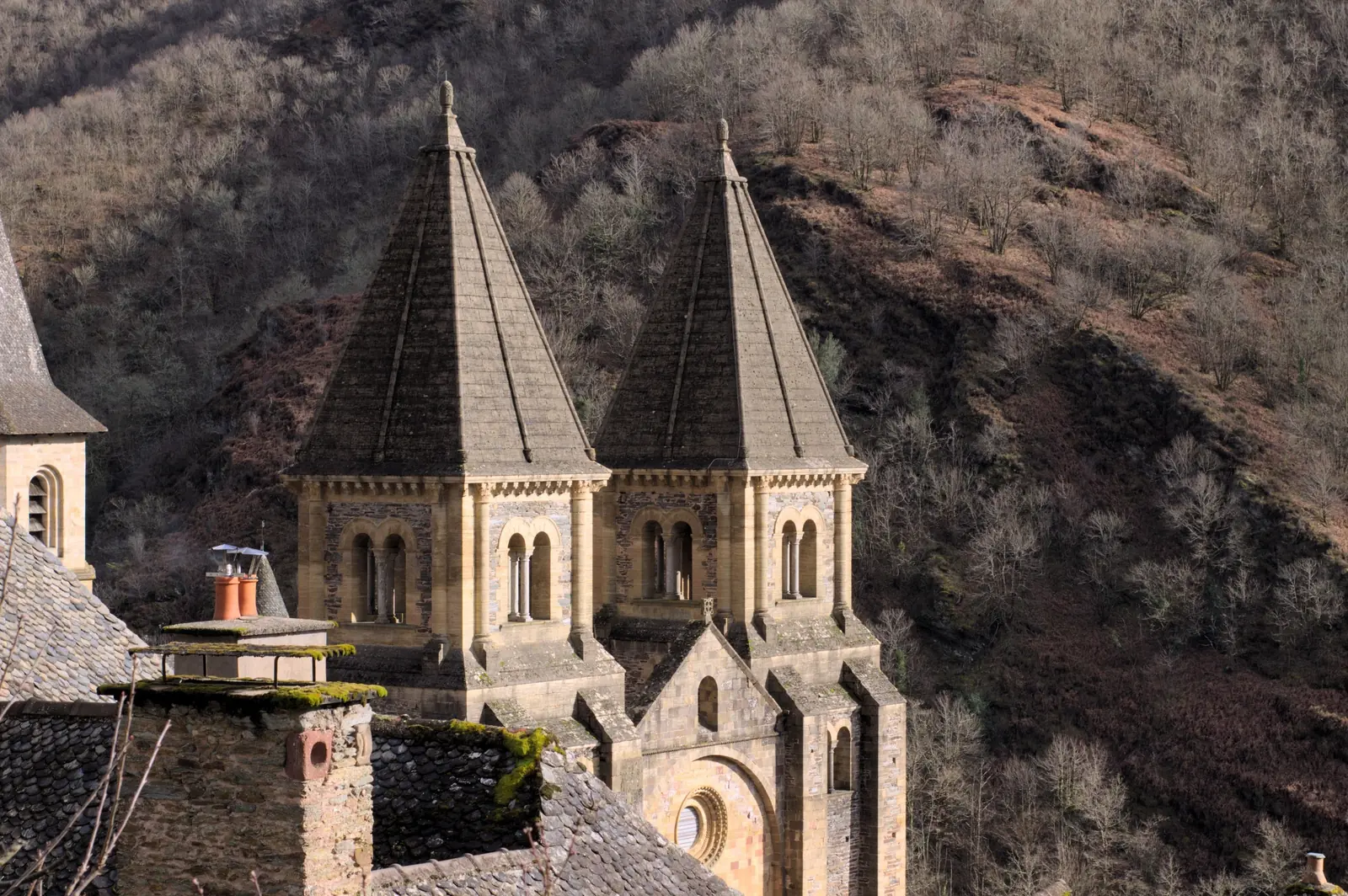
The abbey church was built in the eleventh and twelfth centuries on the plan of the great pilgrimage churches, with a tall nave, galleries, and an ambulatory with chapels around the choir so that crowds could pass the relics. Since 1998 it has been part of the UNESCO World Heritage site of the Routes of Santiago de Compostela in France.
Its 104 windows are the work of the painter Pierre Soulages, born in Rodez on December 24, 1919, who said he had felt his first emotions as an artist at Conques. He worked on them from the late 1980s with the master glassmaker Jean-Dominique Fleury and, after hundreds of trials, chose a colorless glass that lets light through without being transparent. The windows carry no images, and the lead lines make their only design. They were inaugurated in 1994. The galleries, with their carved capitals and a close view of the windows, can be visited only with a guide, for visitors aged twelve and over.
The canons, the pilgrims and the village
Since 1873 the abbey has been in the care of Premonstratensian canons, also called Norbertines, who first came from the abbey of Saint-Michel de Frigolet in Provence at the call of the bishop of Rodez. Since 1992 Conques has been a priory of the abbey of Mondaye in Normandy. A community of seven canons sings the Divine Office in the abbey church, guards the relics and receives pilgrims. Their hostel, open all year, has room for nearly a hundred guests, and walkers share dinner in the large refectory. In the walking season the evening begins with Compline and the blessing of pilgrims, followed by a talk on the tympanum by one of the brothers, a visit of the galleries with music, and the lighting of the tympanum in its colors. The program is on the abbey’s website, abbaye-conques.org.
The village has about 240 inhabitants and is one of the Plus Beaux Villages de France. Pilgrims have been received at Conques since the eleventh century, and below the village they crossed the old bridge called the Roman bridge, which is medieval and was largely rebuilt in the fifteenth and sixteenth centuries. Conques lies on the Le Puy route between Aubrac and Figeac. On our Via Conchae it follows Aubrac, and on Via Gratiae it comes between Le Puy-en-Velay and Rocamadour. Its lanes are steep; see Pilgrimages at a gentle pace. The village is about forty minutes by road from Rodez.
Further reading: Le Puy-en-Velay: A Pilgrim’s Guide to Our Lady of Le Puy; Rocamadour: A Pilgrim’s Guide to Our Lady of Rocamadour; Romanesque France: Cluny and the Churches of the Pilgrim Roads.
To see and to pray
- The tympanumThe Last Judgment, with more than a hundred figures.
- The treasuryThe Majesty of Saint Faith and the gold work of the abbey, once the treasury reopens.
- The windows of Pierre SoulagesOne hundred and four windows of clear glass.
When to go
The abbey church is open all year. From May to September walkers on the Way of Saint James arrive each afternoon, and in season the evening program begins with Compline and the blessing of pilgrims at 8:30 p.m., followed by a talk on the tympanum, music, and the lighting of the tympanum.
The feast of Saint Faith is kept on a Sunday in October, when her reliquary statue is carried in procession. The treasury itself is closed until further notice for safety reasons.
Mass and prayer
Seven Premonstratensian canons keep the abbey and pray the Office in the church: Lauds in the morning, Mass at 11:45 a.m. from Monday to Saturday, Vespers at 6 p.m., and Compline with the blessing of pilgrims. Sunday Mass times change with the season, so check them with the abbey. Nothing is offered in English.
Walking and access
Conques is built on a steep slope, and its paved streets climb and fall. The abbey church has access ramps, and visitors with a disability may be driven up the main street close to the church; coaches stop about two hundred yards from the center. The upper galleries are reached only by stairs.
Feast
- October 6, at ConquesFeast of Saint Faith
The saint of this place
- Saint FaithVirgin and martyr of Agen
On our ways
Getting there
About forty minutes by road from Rodez.
The shrine’s own website, for times and news: abbaye-conques.org
Questions
Is the treasury of Conques open?
Not at present: it is closed until further notice for safety reasons. The Joseph-Fau museum stays open, and the reliquary statue of Saint Faith is still carried in procession on her feast.
Are there tours in English?
Yes. Guided tours of the tympanum, the galleries, the windows and the village are given in English on booking, and a digital tour in English is available.
Should we sleep in Conques?
Yes, if you can. The evening program, from Compline to the lighting of the tympanum, is the best moment of a visit, and the abbey has rooms and dormitories for pilgrims.
How do we get to Conques?
The nearest airport is Rodez, with flights from Paris-Orly; from Rodez, Conques is about forty minutes by road.
Sources
- Abbaye Sainte-Foy de Conques: Histoire de sainte Foy
- Abbaye Sainte-Foy de Conques: L’abbaye Sainte-Foy de Conques
- Conques Tourist Office: The Treasure
- Conques Tourist Office: The Tympanum of the Last Judgment
- Conques Tourist Office: Conques Step by Step (PDF)
- Christian Iconography: The West Tympanum at the Church of St. Foy in Conques
- Different Visions: Transferring Sainte Foy’s Relics from Conques to Agen in 1879
- Wikipedia: Liber miraculorum sancte Fidis
- Wikipedia: Saint Faith
- Musée Soulages, Rodez: Les vitraux de Conques (PDF)
Facts checked against these sources on .
Nearby
- FigeacThe Abbey Church of Saint-Sauveur, about 18 miles as the crow flies
- AubracThe Dômerie of Aubrac, about 29 miles as the crow flies
- RocamadourThe Shrine of Our Lady of Rocamadour, about 41 miles as the crow flies
- CahorsThe Cathedral of Saint-Étienne, about 48 miles as the crow flies