The holy places of France · Auvergne-Rhône-Alpes
Ars The Shrine of the Curé of Ars
Ain, Auvergne-Rhône-Alpes
- Feast
- August 4
- Getting there
- About forty minutes by road from Lyon.
- On our ways
- Via Gratiae, Via Sanctorum
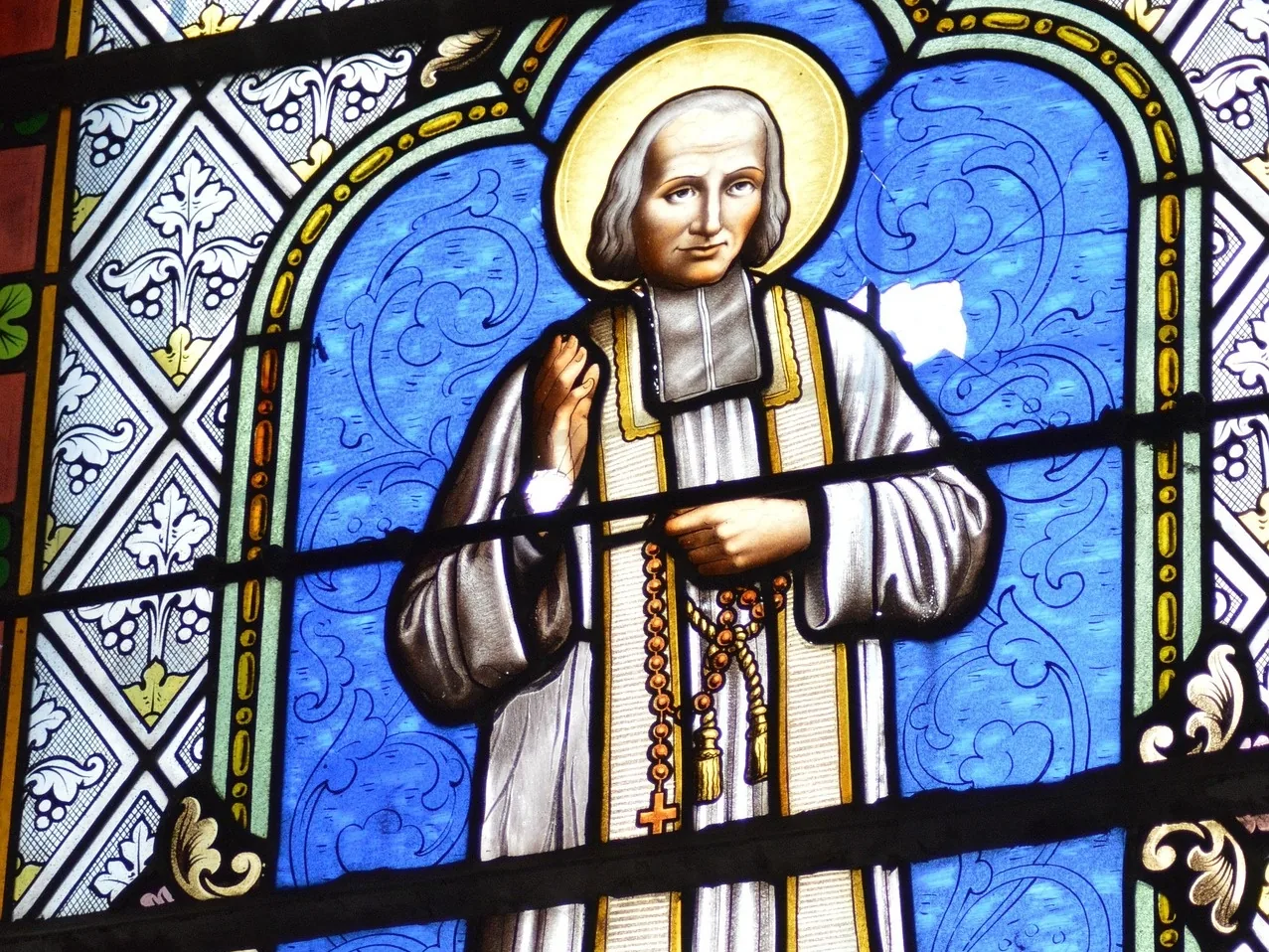
A farmer’s son from Dardilly
Saint John Mary Vianney was born in May 1786 at Dardilly, near Lyon, the fourth of six children of Matthieu and Marie Vianney, farmers known for their help to the poor. His paternal grandparents had given shelter to Saint Benedict Joseph Labre in 1770. He grew up during the Revolution. The family went to distant farms for Masses said in secret by priests in hiding, two nuns whose communities had been dissolved taught him at home, and he made his First Communion at thirteen in a neighbor’s kitchen, with the windows covered so that no candlelight could be seen from outside.
At twenty he began to study for the priesthood at the presbytery school of Abbé Balley in Écully, and Latin gave him great trouble. Drafted in 1809 for Napoleon’s war in Spain, he fell ill, missed his unit and hid among deserters in the mountain village of Les Noës, under the name Jerome Vincent, until an imperial amnesty in 1810 let him return to Écully. He entered the minor seminary of Verrières in 1812 and the major seminary of Lyon in 1813, where his teachers judged him too slow. Balley took him back and argued that his piety made up for his weak learning. He was ordained a priest at Grenoble in August 1815 and returned to Écully as Balley’s assistant.
The parish of Ars
After Balley’s death he was named parish priest of Ars, a village of about 230 people on the Dombes plateau, some 20 miles north of Lyon. Ars had belonged to the Principality of Dombes until it passed to the Kingdom of France in 1762, and in 1956 the commune took the name Ars-sur-Formans, after the river that crosses it. He arrived in February 1818, and the anniversary is still kept on the second Sunday in February. On the way he lost his way, and a young shepherd, Antoine Givre, pointed him toward the village.
He found a parish where the Revolution had left little knowledge of the faith. Sundays were given to work in the fields, the taverns and dancing. He preached against blasphemy and against the dances, and he refused absolution to those who would not give them up. His sermons were later collected and published. With Catherine Lassagne and Benedicta Lardet he founded La Providence, a home for girls, whose building still stands in the village.
He was a Franciscan tertiary and had a strong devotion to Saint Philomena. He built a shrine in her honor, credited her with the cures that others credited to him, and attributed to her his own recovery from a grave illness in May 1843.
The confessional and the crowds
Visitors from outside the parish began to come to him as early as 1827, and by 1855 about 20,000 pilgrims a year reached Ars. Most came to confess. He spent eleven or twelve hours a day in the confessional in winter and up to sixteen in summer, and his bishop excused him from the annual retreat of the diocesan clergy so that he could stay with his penitents.
He longed for the life of a monk and tried to leave Ars four times, the last in 1853, yet he remained its parish priest until his death. The French state awarded him the Legion of Honor.
His death and the Church’s honors
He died in Ars on August 4, 1859, aged seventy-three, after forty-one years as its parish priest. About 300 priests and over 6,000 people came to his funeral, and before burial his body was fitted with a wax mask. Pope Pius IX declared him Venerable on October 3, 1874. Pope Pius X beatified him on January 8, 1905. Pope Pius XI canonized him on May 31, 1925, and in 1929 named him patron of parish priests. His feast is August 4.
Pope John Paul II came on October 6, 1986, the day after his visit to Paray-le-Monial, for the bicentennial of the saint’s birth, which drew delegations from sixty countries. He gave a meditation in three parts to cardinals, bishops, priests, deacons and seminarians from France and other countries, and he celebrated an open-air Mass. Recalling the visit afterward, he said that “the figure of the Holy Curé of Ars does not cease to speak also to the man of today,” and he closed his account by saying that priests are needed, and saints are needed.
For the 150th anniversary of the saint’s death, Pope Benedict XVI proclaimed a Year for Priests. It opened on June 19, 2009, the Solemnity of the Sacred Heart, and ran into June 2010. Nearly 600,000 pilgrims came to Ars that year, among them 35,000 priests. American Catholics could venerate his heart when it toured the United States for six months from November 2018, covering some 36,000 miles, with over 1,200 hours of public veneration.
Visiting the village
The holy places of Ars stand close together. Start with the basilica, designed by the Lyon architect Pierre Bossan and built from 1862 to 1865; his successor, Sainte-Marie Perrin, finished the work. It extends the old church of Saint-Sixte, the medieval village church that John Vianney served for forty-one years. The saint’s body lies in a reliquary in the basilica, and his confessional is kept in the old church. The shrine also has an underground church, Notre-Dame-de-la-Miséricorde.
The presbytery where he lived is kept as he left it, with his room, his kitchen and his books. Beside it, the chapel of the Heart holds his heart in a reliquary. La Providence, the house he founded for girls, stands nearby. Several old crosses stand in and around the village, among them the monumental cross of the jubilee of 1847, raised during his ministry.
On the road into the village, the Monument of the Meeting, a sculpted group, shows the young priest and the shepherd boy Antoine Givre at the spot where, according to the story told in Ars, the boy showed him the way.
Priests in Ars
Ars is a center for priests. The priests of the Société Jean-Marie Vianney run an international seminary in the village, and the Foyer Sacerdotal Jean-Paul II, named for the pope who came in 1986, is a house for priests. Several religious communities also live in Ars, among them Carmelite nuns, whose Carmel was founded in 1939, the Benedictines of the Sacred Heart of Montmartre, Franciscan sisters and the Brothers of the Holy Family of Belley. Parish groups traveling with their pastor will find advice on our page for group leaders.
The shrine receives over 500,000 visitors a year. Its main days are the feast of the saint’s arrival on the second Sunday in February, Divine Mercy Sunday, Corpus Christi, the feast of the saint on August 4, and December 8, when the village is lit up. Ars lies some 20 miles north of Lyon and 6 miles east of Villefranche-sur-Saône, about forty minutes by road from the city. It is a stop on our Via Gratiae and Via Sanctorum. Mass and confession times change with the seasons and are posted on the shrine’s website.
Further reading: Paray-le-Monial: A Pilgrim’s Guide to the Sacred Heart; La Salette: The Apparition of 1846 and the Alpine Shrine; Lyon: A Pilgrim’s Guide to Fourvière and the Martyrs of 177.
To see and to pray
- The basilica and the old churchThe reliquary of Saint John Mary Vianney, and his confessional.
- The presbyteryHis room, his kitchen and his books.
- The chapel of the HeartWhere his heart is kept.
When to go
The shrine is open all year; the basilica opens at 6:30 a.m. and closes at 8 p.m., later in summer. The great day is August 4, the feast of the Curé of Ars, prepared by a night of adoration and kept with a solemn Mass, the veneration of his heart and a procession. A procession also marks the anniversary of his arrival, in early February.
Mass and prayer
Mass is celebrated three times a day in the basilica, and confessions are heard each morning and afternoon. Lauds, Vespers and the rosary are prayed each day, and the Blessed Sacrament is adored day and night in the chapel of the Providence. No Mass in English is published; a film on his life has English subtitles.
Walking and access
The village is small and flat. The basilica can be visited in a wheelchair, but the Curé’s house is not accessible: his room is upstairs. The walk to the monument of his meeting with the shepherd boy takes about forty-five minutes there and back.
Feast
- August 4Feast of Saint John Mary Vianney
The saint of this place
- Saint John Mary VianneyThe Curé of Ars, patron of parish priests
On our ways
Getting there
About forty minutes by road from Lyon.
The shrine’s own website, for times and news: arsnet.org/en
Questions
How long should we stay in Ars?
Half a day is enough for the basilica, the Curé’s house and the chapel of the Heart; a full day leaves time for Mass, confession and the walk to the monument of the meeting.
Is the shrine free?
Yes, the basilica is free. The wax museum is a separate, paid visit.
How do we get to Ars?
Ars is about forty minutes by road from Lyon and its airport. By train, go to Villefranche-sur-Saône and take a taxi for the last six miles.
Sources
- Wikipedia, John Vianney
- Wikipedia, Ars-sur-Formans
- Wikipedia, Pierre Bossan
- Wikipedia, Saint Philomena
- The Holy See, John Paul II in France, October 4 to 7, 1986 (program and texts)
- EWTN, John Paul II recalling his third visit to France
- The Holy See, John Paul II, general audience of October 15, 1986 (Spanish)
Facts checked against these sources on .
Nearby
- LyonFourvière and the Martyrs of Lyon, about 16 miles as the crow flies
- Berzé-la-VilleThe Monks’ Chapel, about 26 miles as the crow flies
- ClunyThe Abbey of Cluny, about 31 miles as the crow flies
- TournusThe Abbey of Saint-Philibert, about 40 miles as the crow flies