The holy places of France · Normandy
Lisieux The Shrine of Saint Thérèse
Calvados, Normandy
- Feasts
- October 1, July 12
- Getting there
- Under two hours by train from the Gare Saint-Lazare in Paris.
- On our ways
- Via Gratiae, Via Rosarum
Eleven years at Les Buissonnets
Thérèse Martin was born in Alençon on January 2, 1873, the youngest of the five daughters of Louis and Zélie Martin who lived to adulthood. Her mother died on August 28, 1877, when Thérèse was four. That November Louis Martin moved with his daughters to Lisieux, to be near Zélie’s brother, the pharmacist Isidore Guérin, and rented a house just outside the town, on the road to Pont-l’Évêque, which the family called Les Buissonnets. Thérèse lived there for eleven years.
From October 1881 to about March 1886 she was a half-boarder at the school of the Benedictine abbey of Notre-Dame-du-Pré, where she made her First Communion on May 8, 1884. Her sister Pauline entered the Carmel of Lisieux on October 2, 1882, and the next year Thérèse, then ten, fell gravely ill. On Pentecost Sunday, May 13, 1883, she was cured at Les Buissonnets after, as she later wrote, the statue of the Virgin in her room smiled at her.
Her sister Marie entered the same Carmel on October 15, 1886. At Christmas that year Thérèse received what she called “the grace of my complete conversion.” In 1887 she prayed for Henri Pranzini, a murderer condemned to death, and took the news that he had kissed a crucifix before his execution as the sign she had asked for.
On Pentecost, May 29, 1887, she asked her father in the garden for leave to enter the Carmel. To enter so young she needed the bishop’s permission, and on October 31, 1887, she went with her father to Bayeux to ask Bishop Hugonin for it. During a pilgrimage to Rome she put her request to Pope Leo XIII himself at the audience of November 20, 1887. She learned of the bishop’s consent on January 1, 1888, and entered the Carmel on April 9, 1888, at fifteen.
Nine years in the Carmel
Sister Thérèse of the Child Jesus received the habit on January 10, 1889, and made her profession on September 8, 1890. Her father died on July 29, 1894, and her sister Céline entered the Carmel on September 14, 1894, so that four of the five Martin sisters lived in the same convent.
In her last manuscript she described her way to God. Too small, she wrote, “to climb the rough stairway of perfection,” she looked for “a little way, a way that is very straight, very short, and totally new” (Story of a Soul, Manuscript C), and found the elevator she needed in the arms of Jesus. The Holy See’s biography calls it the little way of spiritual childhood, a way of trust in God’s merciful love in the small duties of each day. She taught it to the novices in her care.
On April 3, 1896, she first coughed up blood, the first sign of the tuberculosis that killed her. She was moved to the infirmary on July 8, 1897, and died there on September 30, 1897, at twenty-four. Her last words, as the Holy See’s biography records them, were “My God…, I love you!”
Story of a Soul and the Church’s judgment
Thérèse wrote her memories in three manuscripts. She gave the first to her sister Pauline, Mother Agnes of Jesus, in January 1896, for her feast, and began the last in June 1897 for her prioress, Mother Marie de Gonzague. From them the Carmel prepared Story of a Soul, with Mother Agnes taking a large part in the work, and the book appeared in October 1898. Her uncle Isidore Guérin paid for a first printing of 1,000 copies and for a second thousand when those sold out.
The diocesan process for her cause opened in 1910, and Pope Pius X signed the introduction of the cause in Rome on June 10, 1914. Pope Pius XI beatified her on April 29, 1923, canonized her on May 17, 1925, and named her patroness of the missions, with Saint Francis Xavier, on December 14, 1927. On May 3, 1944, Pope Pius XII declared her secondary patroness of France, with Saint Joan of Arc. On October 19, 1997, Saint John Paul II proclaimed her a Doctor of the Church in the apostolic letter Divini Amoris Scientia.
Les Buissonnets and the cathedral
Les Buissonnets is a small middle-class house with a garden behind it. A cousin of Thérèse bought it in 1909, and the Oblates of Saint Thérèse have cared for it since 1931. The visit includes the dining room, where she ate her last meal with her family before entering the Carmel, the kitchen, whose fireplace the sanctuary links to the grace of Christmas 1886, and the bedroom where she was cured. A statue in the garden commemorates her request to her father at Pentecost 1887.
The cathedral of Saint-Pierre was begun by Bishop Arnoult in 1149 and survived the bombing of 1944. The Martins came here for Sunday Mass for over ten years, and a marble plaque in the south ambulatory marks the place where they attended High Mass. The high altar was a gift of Louis Martin. Thérèse made her first confession in a chapel of the north ambulatory and prayed for Pranzini in the Lady chapel at the east end. That chapel was built by Pierre Cauchon, bishop of Lisieux from 1432 until his death in 1442, who in 1431 had presided at Rouen over the trial that condemned Joan of Arc. He is buried in it.
The Carmel chapel and the basilica
The Carmelite nuns still live in the monastery, and its enclosure cannot be visited, but the chapel is open to all. Built in the 1840s, it was enlarged in 1923 for the growing number of pilgrims. On March 26, 1923, Thérèse’s remains were brought here from the town cemetery. Bones of the chest were placed in the shrine, a reliquary in the form of a statue of the saint, and most of the others in a small reliquary beneath it; the bones of her right forearm are kept in the basilica. Above the shrine stands the Virgin of the Smile, the family statue before which she was cured, which Céline brought to the Carmel in 1894. The Memorial in the chapel courtyard, opened in 2015, presents her life in the Carmel.
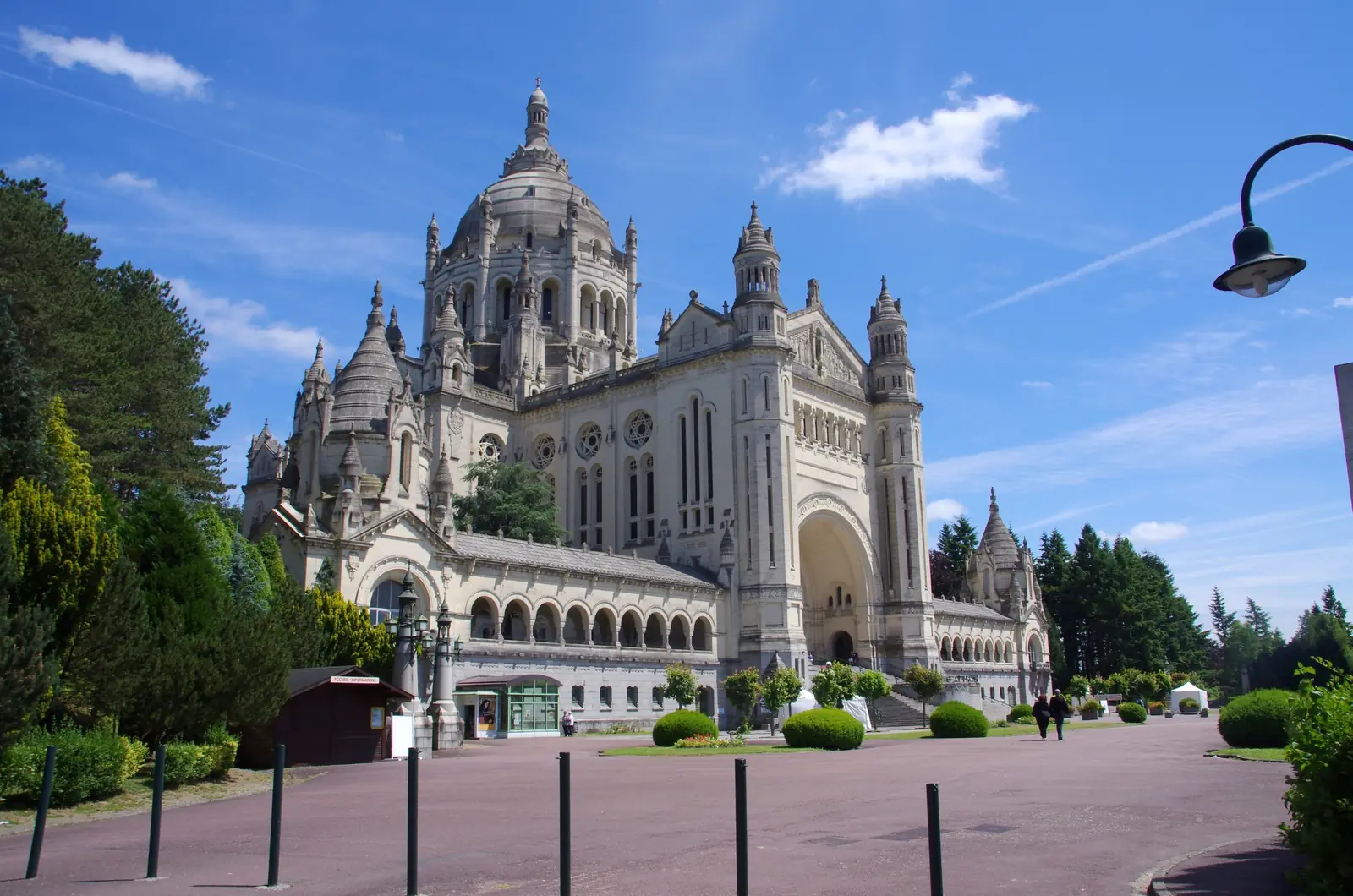
The first stone of the basilica, designed by Louis-Marie Cordonnier, was laid on September 30, 1929. That November Pius XI told Bishop Suhard to make it “very big, very beautiful, and as quickly as possible,” according to the sanctuary. Cardinal Eugenio Pacelli, the future Pius XII, blessed it on July 11, 1937, and it was consecrated on July 11, 1954. Its dome rises about 295 feet, and Pierre Gaudin designed its mosaics and windows.
Five mosaics in the crypt, installed in 1958, show her baptism, her cure, her First Communion, her profession and her death. Next to the crypt, the chapel of the Martin family holds the reliquary of Saints Louis and Zélie Martin, canonized together on October 18, 2015. Their feast on July 12 is kept with a solemn Mass in the basilica.
The cemetery and the feasts
Thérèse was buried in the town cemetery on October 4, 1897, the first nun laid in the plot of the Carmelites. A cross marks her first grave, and a kneeling statue of her marks the second, beneath which several of the Carmelites closest to her are buried. The Martin family tomb is in the same cemetery, and the relics of Louis and Zélie are now kept in the basilica.
The Feasts of Saint Thérèse take place around the anniversary of her death on September 30 and her feast on October 1. In 2026 they ran from September 19 to October 4. They opened with a torchlight procession carrying her reliquary from the Carmel to the basilica, included a pilgrimage to the cemetery on September 30 and a solemn Mass on October 1, and closed on Sunday, October 4, when the reliquary was carried back to the Carmel. The program changes each year and is published on the sanctuary’s website.
Alençon, Bayeux and a stay in Lisieux
Lisieux is the last stage of Via Rosarum, which begins in Paris at Notre-Dame-des-Victoires and, after the basilica of Montligeon, reaches Alençon, with the house where Thérèse was born and the basilica of Notre-Dame, where she was baptized on January 4, 1873, and where her parents had married on July 13, 1858. Since July 12, 2025, a smaller copy of the Lisieux reliquary of Louis and Zélie, with relics of their forearms, has been kept in that basilica. At Bayeux the former bishop’s house where Thérèse made her request now houses the town’s museum of art and history. Lisieux is also a stage of Via Gratiae.
The sanctuary’s guest house for pilgrims, the Ermitage Sainte-Thérèse, stands next to the Carmel at 23 rue du Carmel, with 92 rooms for up to 192 people, meals and a chapel of Our Lady of the Smile. The Sisters Servants of Saint Thérèse of the Child Jesus and lay staff receive individuals, families and groups there. Trains from the Gare Saint-Lazare in Paris reach Lisieux in under two hours.
Further reading: Catholic Pilgrimage to France: A Practical Planning Guide.
To see and to pray
- The chapel of the CarmelHer shrine, beneath the statue of the Virgin of the Smile.
- Les BuissonnetsThe family house, with its garden.
- The basilica of Saint ThérèseIts mosaics, and the crypt.
- The cathedral of Saint-PierreWhere the Martin family went to Mass.
When to go
The shrine is open all year. Its fullest season runs from April to October, and in July and August a Eucharistic procession is held on Wednesday evenings and a Marian procession on Saturday evenings.
The feasts of Saint Thérèse take up the second half of September and the first days of October, with a torchlight procession of her relics, a pilgrimage to the cemetery on September 30, the anniversary of her death, and Mass on her feast, October 1. July 12 is the feast of Saints Louis and Zélie Martin.
Mass and prayer
Mass is celebrated several times a day in the chapel of the Carmel, the crypt of the basilica and the cathedral of Saint-Pierre, and confessions are heard each day at the basilica. There is no regular Mass in English; groups may ask the shrine for a chaplain, and the guided visits of the Carmel are given in several languages.
Walking and access
The town is small, and the station is a ten-minute walk from the Carmel and the basilica. The climb to the dome is some 300 steps; pilgrims who walk with difficulty should ask the shrine about step-free access to the crypt and the upper church. Les Buissonnets, a family house on several floors, is harder for those who walk with difficulty.
Feasts
- October 1Feast of Saint Thérèse of Lisieux
- July 12, kept in the Discalced Carmelite calendar and at Lisieux and AlençonFeast of Saints Louis and Zélie Martin
The saints of this place
- Saint Thérèse of LisieuxCarmelite and Doctor of the Church
- Saints Louis and Zélie MartinParents of Saint Thérèse, the first married couple canonized together
On our ways
Getting there
Under two hours by train from the Gare Saint-Lazare in Paris.
The shrine’s own website, for times and news: therese-de-lisieux.catholique.fr/en
Questions
How long should we stay in Lisieux?
One full day covers the Carmel, Les Buissonnets, the cathedral and the basilica. With Alençon, where Thérèse was born, a pilgrimage in her steps takes two or three days.
Are the places of Saint Thérèse free to visit?
Yes. The chapel of the Carmel, Les Buissonnets, the cathedral and the basilica are free; the guided visit and the climb to the dome are paid.
Where are the relics of Saint Thérèse and her parents?
Her shrine is in the chapel of the Carmel, beneath the statue of the Virgin of the Smile. The reliquary of her parents, Saints Louis and Zélie Martin, is in the Martin family chapel beside the crypt of the basilica, and a relic of their forearms has been in the basilica of Notre-Dame in Alençon since 2025.
Nearby
- Le Bec-HellouinThe Abbey of Notre-Dame du Bec, about 23 miles as the crow flies
- CaenThe City of Saint John Eudes, about 27 miles as the crow flies
- Saint-WandrilleThe Abbey of Saint-Wandrille, about 36 miles as the crow flies
- BayeuxThe Cathedral of Notre-Dame of Bayeux, about 43 miles as the crow flies