Saint Thérèse of Lisieux
Carmelite and Doctor of the Church1873–1897
Feast · October 1
- Patron of
- Patroness of the missions, with Saint Francis Xavier (Pius XI, December 14, 1927)
Life
Thérèse Martin was born in Alençon on January 2, 1873, the youngest of the five daughters of Louis and Zélie Martin who lived to adulthood. Her mother died on August 28, 1877, and that November her father moved the family to Lisieux, to a house called Les Buissonnets. On Pentecost 1883 she was cured of a grave illness, through the intercession of Our Lady of Victories, as the Holy See’s letter on her doctorate records. At Christmas 1886 she received what she called her “complete conversion.”
She wished to enter the Carmel of Lisieux at fifteen. On October 31, 1887, she went with her father to Bayeux to ask Bishop Hugonin for permission, and on November 20, 1887, during a pilgrimage to Rome, she put her request to Pope Leo XIII. After some reluctance the bishop consented, and she entered the Carmel on April 9, 1888. She received the habit on January 10, 1889, with Bishop Hugonin presiding, and made her profession on September 8, 1890, as Sister Thérèse of the Child Jesus and of the Holy Face.
In the Carmel she wrote the memories of her life that were later published as Story of a Soul, in which she described her little way of trust and love. In the night between Holy Thursday and Good Friday, April 3, 1896, she had the first sign of the tuberculosis that killed her. She was moved to the infirmary on July 8, 1897, and died on the afternoon of September 30, 1897, at twenty-four. In a letter to Father Bellière she had written: “I am not dying; I am entering life.”
Further reading: Lisieux: A Pilgrim’s Guide to the Town of Saint Thérèse; Catholic Pilgrimage to France: A Practical Planning Guide; Sacred Heart in France: Paray-le-Monial to Montmartre.
Cult and relics
Story of a Soul appeared at Lisieux in 1898 and soon spread her name across the world. Pope Pius XI beatified her on April 29, 1923, canonized her on May 17, 1925, and on December 14, 1927, named her patroness of the missions, equal with Saint Francis Xavier. On May 3, 1944, Pope Pius XII named her secondary patroness of France, with Saint Joan of Arc, and on October 19, 1997, Saint John Paul II proclaimed her the thirty-third Doctor of the Church. Pope Francis devoted to her the apostolic exhortation C’est la confiance, published on October 15, 2023, for the 150th anniversary of her birth and the centennial of her beatification.
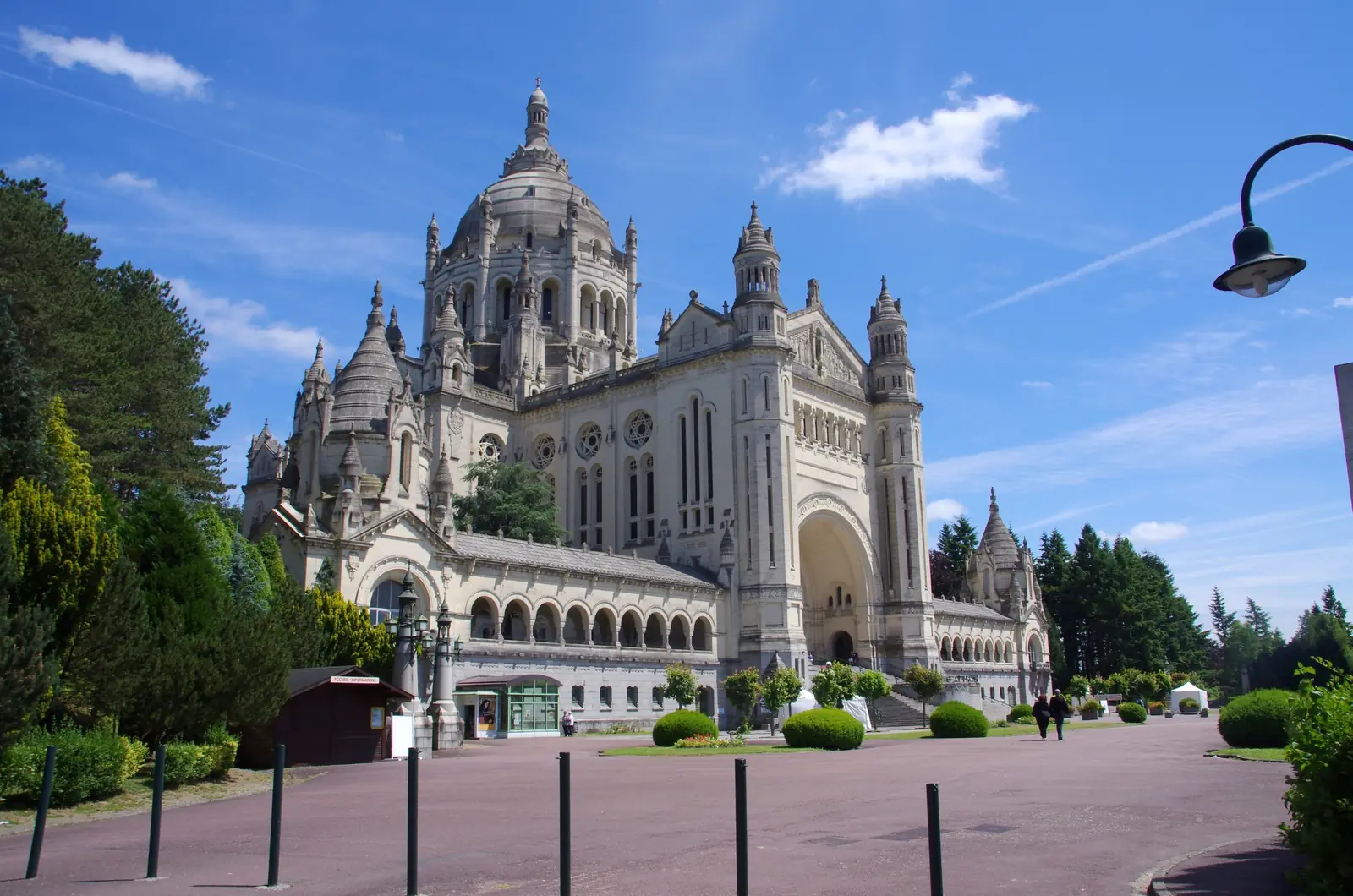
Her relics rest in a shrine in a side chapel of the chapel of the Carmel of Lisieux, which was enlarged in 1923 for her beatification; the chapel is open to all, while the monastery itself remains enclosed. The basilica of Lisieux, built in her honor, was begun in 1929 and completed in 1937, and its mosaics and stained glass were finished in 1954.
In art
She is shown in the Carmelite habit, holding roses and a crucifix. The image goes back to the portraits painted by her sister Céline, Sister Geneviève of the Holy Face, who judged her Thérèse aux roses of 1925 the most faithful of the likenesses she made. The portrait by Roybet of 1917, showing Thérèse standing in a cloister with roses and her crucifix, is kept in the great sacristy of the basilica of Lisieux.
Patron of
Patroness of the missions, with Saint Francis Xavier (Pius XI, December 14, 1927); secondary patroness of France, with Saint Joan of Arc (Pius XII, May 3, 1944).
Where to pray
- AlençonThe house on the rue Saint-Blaise where she was born, kept by the sanctuary of Alençon and open to visitors.
- Lisieux, Les BuissonnetsThe family house where she lived for eleven years, from 1877 until she entered the Carmel.
- Lisieux, chapel of the CarmelThe chapel of the monastery where she lived from 1888 to 1897, with her shrine in a side chapel.
- Lisieux, Basilica of Saint ThérèseThe basilica built in her honor from 1929 to 1937, with the Martin family chapel beside its crypt.
- BayeuxThe episcopal city where, on October 31, 1887, at fourteen, she asked Bishop Hugonin with her father for leave to enter the Carmel.
Questions
Where is Saint Thérèse buried?
Her relics rest in a shrine in a side chapel of the chapel of the Carmel of Lisieux, which is open to all; the monastery itself remains enclosed. The basilica of Lisieux, built in her honor from 1929 to 1937, is a separate church.
Where was Saint Thérèse born?
In Alençon, in the family house on the rue Saint-Blaise, which is kept by the sanctuary of Alençon and open to visitors.
When is the feast of Saint Thérèse?
October 1.