The holy places of France · Normandy
Mont-Saint-Michel The Abbey of Mont-Saint-Michel
Manche, Normandy
- Feasts
- September 29, September 10
- Getting there
- High-speed train from Paris to Rennes, then about an hour and ten minutes by coach; a shuttle crosses the causeway.
- On our ways
- Via Gratiae, Via Archangeli
Saint Aubert and the founding
Before it was dedicated to the archangel, the rock in the bay was called Mont Tombe and belonged to the diocese of Avranches. According to the tradition of the Mount, Saint Michael appeared three times in 708 to Saint Aubert, bishop of Avranches, and asked for a sanctuary on the rock; at the third appearance he touched the hesitant bishop’s skull with his finger. A skull marked by a hole, venerated as Aubert’s, is kept in the basilica of Saint-Gervais in Avranches.
The same tradition says that Aubert sent monks to bring back relics from the shrine of Saint Michael on Monte Gargano, in southern Italy, and that on October 16, 709, he dedicated the church and installed twelve canons to serve it. The date of 708 comes from a chronicle written at the abbey, and other records mention the Mount only from the middle of the ninth century. The first pilgrim known by name, a Frankish monk called Bernard, came in 867 or 868.
The Benedictine centuries
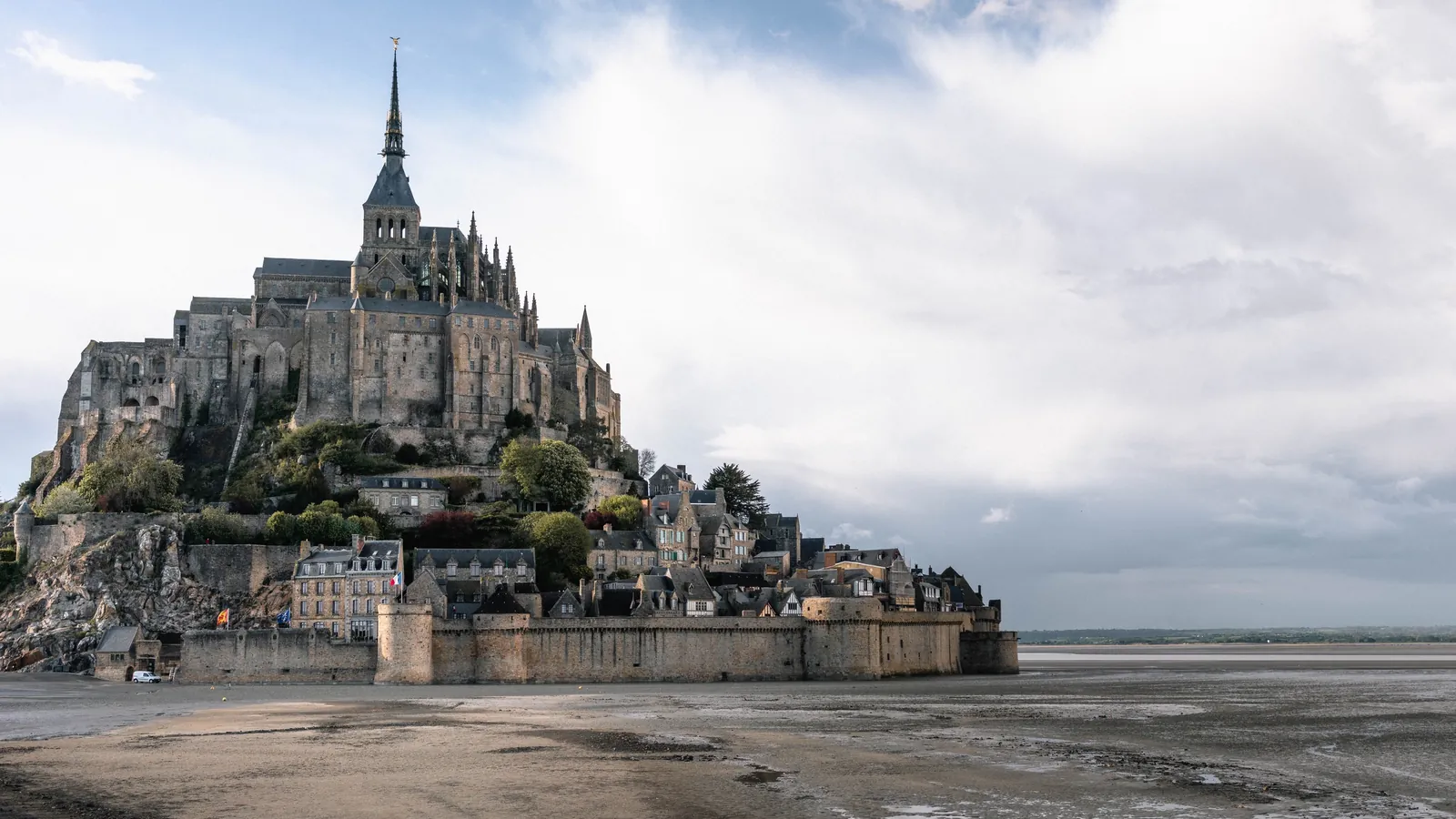
In 966 Duke Richard I of Normandy replaced the canons with Benedictine monks led by Abbot Maynard, who came from Saint-Wandrille. Their pre-Romanesque church of Notre-Dame-sous-Terre, with two parallel naves, survives as a crypt beneath the later church. In the eleventh century the monks began the Romanesque abbey church on the summit, set on crypts built around the top of the rock, and the abbey marked the thousandth anniversary of the start of the work in 2023.
In 1204 troops led by Guy of Thouars besieged the Mount. The abbey held, but fire from the burning village damaged it, and King Philip Augustus paid for new Gothic buildings on the north side. Built between 1211 and 1228 on three levels against the cliff, they came to be called the Merveille, the Marvel. The almonry, where the monks received the poor and pilgrims, and the cellar are at the bottom, the guests’ hall and the Knights’ Hall in the middle, and the refectory and the cloister at the top.
The Romanesque choir collapsed in 1421 and was rebuilt in the Flamboyant Gothic style from 1446 into the early sixteenth century. In 1776, after a fire, the three western bays of the nave were pulled down, and a classical front was built in 1780.
Miquelots, war and prison
Medieval pilgrims to the Mount, called miquelots, came from all over France and from the German lands, Scotland and Ireland, and pilgrimages of children and young people were common from the fifteenth to the seventeenth century. They came by many roads and could cross the sands only at low tide. They carried a document certifying their pilgrimage and bought pilgrim badges in the village to take home. Today most walkers come from the east, on a line from Chartres through Alençon, along old routes waymarked since 1998 as the chemins montois.
During the Hundred Years’ War the abbey was fortified, and the English besieged and blockaded the Mount three times without taking it. Two bombards left by the English remain at the Mount. Saint Joan of Arc named Saint Michael among the voices she heard, and in 1469 Louis XI founded the Order of Saint Michael and intended the abbey church as its chapel, a plan that was never carried out.
From 1523 the abbey was held by commendatory abbots, and the community declined. The Benedictines of the Congregation of Saint-Maur took it over in 1622 and stayed until the Revolution. In 1791 the abbey was turned into a prison, which Napoleon III closed in 1863, when some 650 inmates were moved elsewhere. A great wooden wheel, turned by prisoners walking inside it, pulled loads up a stone ramp and can still be seen.
The abbey since 1863
After 1863 the bishop of Coutances leased the abbey, and the state began restoring it in the 1870s. In the 1890s a neo-Gothic spire was raised over the church and crowned with Emmanuel Frémiet’s gilded statue of Saint Michael. Catholic worship resumed in the abbey church in 1922. Monks returned for the thousandth anniversary of the Benedictine foundation in 1966, and a small community settled there in 1969. UNESCO inscribed Mont-Saint-Michel and its Bay on the World Heritage List in 1979.
On June 24, 2001, at the invitation of the diocese, the Monastic Fraternities of Jerusalem, founded in Paris in 1975, took over the prayer of the abbey, which remains state property. The Centre des monuments nationaux has managed it, but in June 2026 the government announced that the Établissement public du Mont-Saint-Michel will take over the management of the whole site, abbey included. In June 2026 the diocese announced that the brothers will leave in the summer of 2027, as part of a reorganization of their congregation. The sisters will stay and continue the liturgy and the welcome of pilgrims.
Priests of the Community of Saint-Martin have charge of the pastoral care of the sanctuary and of the parish church of Saint-Pierre, and one of them, Don Pierre Doat, is the rector. On July 23, 2026, during the summer pèlerinage des Grèves, Bishop Grégoire Cador of Coutances promulgated the sanctuary’s first written statutes. They define the sanctuary as the abbey, the church of Saint-Pierre and the priory of Ardevon, about 3 miles away on the mainland.
The abbey in the order of the visit
The Grand Degré, a stair of about 190 steps, climbs some 90 feet to the abbey. At the top, the west terrace overlooks the bay from the place where the first bays of the nave once stood. The church has a Romanesque nave of the late eleventh century and a Flamboyant Gothic choir, where Mass and the Office are celebrated.
From the church the route leads into the top level of the Merveille. The cloister, finished in 1228, is where the monks walked and read around a garden enclosed by granite columns. Beside it, the refectory is a long hall whose windows cannot be seen from the entrance. One level down is the guests’ hall, with two naves and two great fireplaces, where the abbot received important visitors.
Below lie the crypts that carry the church. The chapel of Saint-Martin was used for funeral rites, and the crypt of the Great Pillars, built for the new choir after 1421, rests on ten massive round columns. Near the ossuary stands the prisoners’ wheel, and the chapel of Saint-Étienne was once the chapel of the dead. The route also passes through the Promenoir des Moines, a vaulted walk of the twelfth century, and the Knights’ Hall, named after the Order of Saint Michael. Allow an hour and a half to two hours, and buy tickets online to avoid the lines.
Crossing the bay on foot
The usual crossing on foot starts at the Bec d’Andaine, near Genêts on the north shore of the bay, and covers a little over four miles of sand, passing the islet of Tombelaine on the east or the west as the guide decides.
The tides of the bay are among the strongest in Europe, with a range of up to about 49 feet, and the sands hold quicksand. The crossing is very dangerous without a guide, and the tourist office states that a walk in the bay must always be made with one. The companies of bay guides, such as Chemins de la Baie, lead crossings that must be booked ahead.
Check the tide tables published by the tourist office before you go. During the highest spring tides, at coefficients above 100, the sea covers the approaches and access to the Mount is cut off for a time. Do not walk out onto the sands alone, even a short way from the ramparts.
The Office and staying the night
The community sings Lauds in the morning, Mass at midday and Vespers in the late afternoon from Tuesday to Saturday, with Lauds and a late-morning Mass on Sunday. There is no Office in the abbey on Sunday evening or on Monday, the communities’ day of solitude. Attendance is free, and in winter the community prays in the crypt of Notre-Dame-des-Trente-Cierges. Times change with the seasons and are posted by the tourist office and on the abbey community’s website.
In the village, the small parish church of Saint-Pierre has a well-known statue of Saint Michael, is free to enter and has Mass daily. At the foot of the rock, the little chapel of Saint-Aubert is dedicated to the founder. At the Mount the feast of Saint Michael falls on September 29, and the anniversary of the dedication is kept on October 16. It is the last stage of Via Archangeli and a stage of Via Gratiae.
Most of the two and a half million or more visitors a year leave by evening, and late at night the lanes are quiet. The village has hotels, and the sanctuary’s pilgrim house, a few steps below the abbey, gives lodging and meals to pilgrims who arrive on foot or by bicycle. Groups can stay at the priory of Ardevon, a thirteenth-century house of the abbey, with dormitories for up to 50 people. Cars are left in the parking lots on the mainland, about 1.5 miles away, and free shuttles and the footbridge cover the rest of the way.
Further reading: Catholic Pilgrimage to France: A Practical Planning Guide.
To see and to pray
- The abbey churchAt the top of the rock, with its Romanesque nave and Gothic choir.
- The MerveilleThe cloister and the refectory of the thirteenth century, built on three levels against the cliff.
- The bayCrossed on foot at low tide with a certified guide.
When to go
The abbey is open every day except January 1, May 1 and December 25, until 7 p.m. from May to August and until 6 p.m. the rest of the year. Crowds peak in the afternoon; the Mount is quieter early in the morning and in the evening, and our groups spend the night there.
The feast of Saint Michael, September 29, is kept with a novena and a week of celebrations, with a procession to the abbey, the blessing of the sea and a pilgrimage across the bay. October 16 recalls the dedication of the first sanctuary in 709.
Mass and prayer
The Monastic Fraternities of Jerusalem sing Lauds, Mass and Vespers in the abbey church from Tuesday to Saturday, and Lauds and Mass on Sunday morning. There is no Office on Sunday evening or on Monday, and in winter the Office moves to the crypt. You join it without a ticket by meeting a member of the community at the top of the main street a quarter of an hour before it begins. Mass is also celebrated each day in the parish church of Saint-Pierre, in the village.
The brothers of the community are due to leave in the summer of 2027; the sisters stay, with the Community of Saint-Martin, which now runs the sanctuary. The hours of the Office may change, so check them before you come.
Walking and access
The Mount is hard going for anyone who walks with difficulty. Nearly three hundred steps lead up to the abbey, there are no ramps or elevators in the village or in the abbey, and the abbey’s managers advise visitors with reduced mobility to plan nothing else that day. The free shuttle stops about four hundred yards from the gate of the Mount.
Feasts
- September 29Feast of Saint Michael the Archangel
- September 10, in the diocese of Coutances and AvranchesFeast of Saint Aubert
- October 16Anniversary of the dedication of the first sanctuary, in 709
The saints of this place
- Saint Michael the ArchangelPrince of the heavenly host, protector of the Church
- Saint AubertBishop of Avranches, founder of Mont-Saint-Michel
On our ways
Getting there
High-speed train from Paris to Rennes, then about an hour and ten minutes by coach; a shuttle crosses the causeway.
The shrine’s own website, for times and news: abbaye-mont-saint-michel.fr/en
Questions
Can we stay overnight on Mont-Saint-Michel?
Yes. A few hotels stand inside the walls. A night on the Mount lets you attend the evening Office and see the Mount after the day visitors leave; our groups do so on Via Gratiae and Via Archangeli.
Do we pay to enter the abbey?
Yes. Entry costs €16 from April to September and €13 from October to March, and is free for visitors under eighteen. The village and the parish church are free, and groups must book.
Can we cross the bay on foot?
Yes, but only with a certified guide, because of the tides and the quicksand. The crossing is made barefoot on the sand and takes a few hours.
Is there Mass in English?
No regular Mass in English is offered on the Mount. On our pilgrimages, the priest who travels with the group celebrates Mass in English.
Sources
- Mont-Saint-Michel Tourist Office: Religious life at the abbey
- Mont-Saint-Michel Tourist Office: Easy-to-read guide to the Mount
- French Ministry of Culture: Pilgrimage and walking practices at Mont-Saint-Michel
- Aleteia: Why the sanctuary of Mont-Saint-Michel is adopting new canonical statutes (July 22, 2026)
- InfoVaticana: The monks of the Fraternities of Jerusalem will leave the Mont Saint-Michel Abbey in 2027
- Aleteia: 24 hours at Mont-Saint-Michel (May 14, 2026)
- Catholic Encyclopedia: Mont-Saint-Michel
- World History Encyclopedia: Mont Saint-Michel
- Wikipedia: Mont-Saint-Michel Abbey
- French Moments: Mont-Saint-Michel Abbey
- National Assembly: written question on the management of Mont-Saint-Michel and the government’s answer (2026)
Facts checked against these sources on .
Nearby
- AvranchesSaint-Gervais and the Scriptorial, about 8 miles as the crow flies
- CoutancesThe Cathedral of Notre-Dame of Coutances, about 29 miles as the crow flies
- Montfort-sur-MeuThe Birthplace of Saint Louis-Marie de Montfort, about 40 miles as the crow flies
- BayeuxThe Cathedral of Notre-Dame of Bayeux, about 57 miles as the crow flies