Saint Charles de Foucauld
Priest and hermit of the Sahara1858–1916
Feast · December 1, in the proper calendars of North Africa and of the archdiocese of Paris
- Where to pray
- Strasbourg, Paris, Notre-Dame-des-Neiges, Viviers
Life
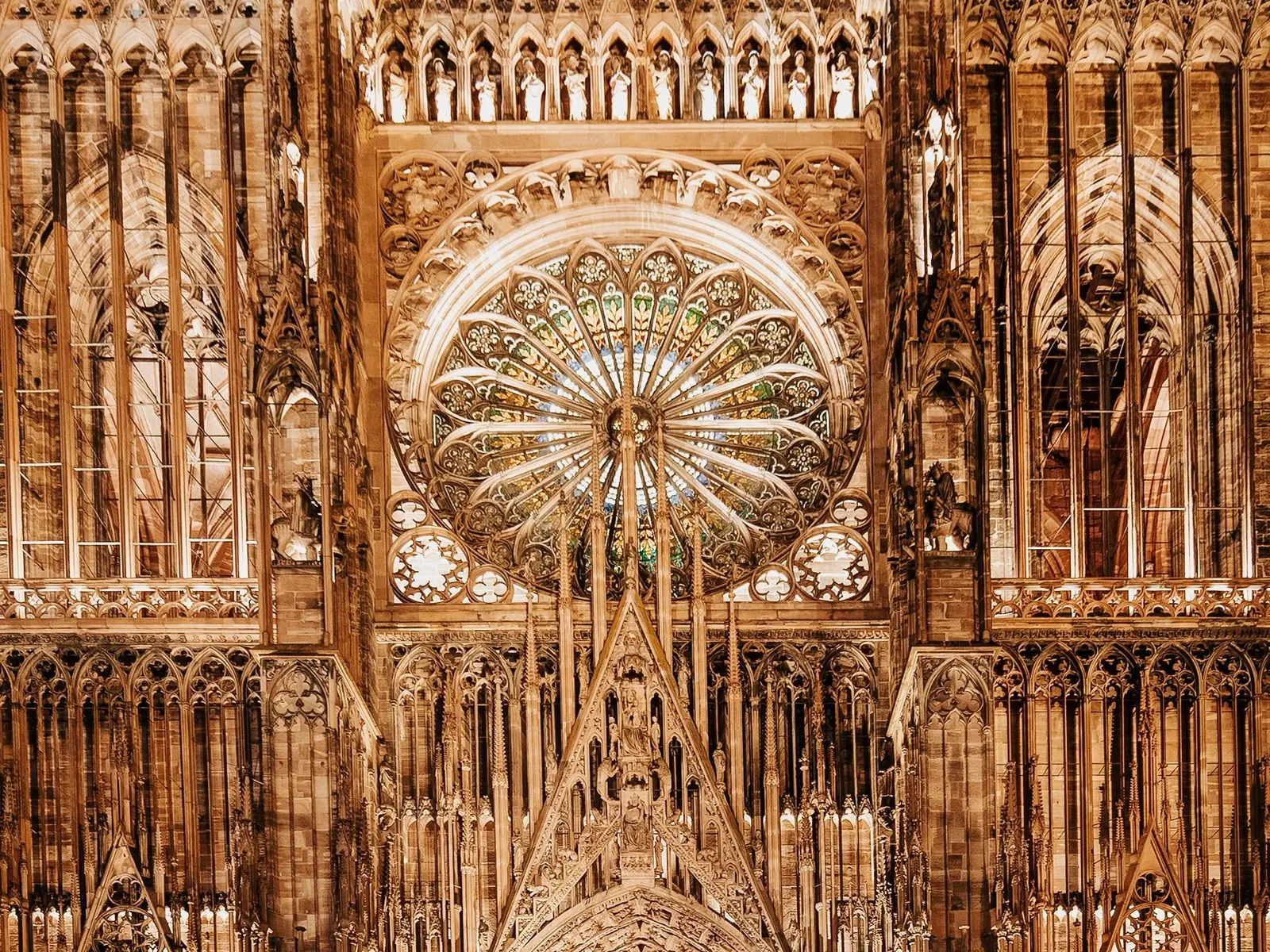
Charles de Foucauld was born in Strasbourg on September 15, 1858, at 3 place Broglie, in a house that belonged to his mother. He was baptized on November 4, 1858, at Saint-Pierre-le-Jeune, a church then shared by Catholics and Protestants. His mother died on March 13, 1864, and his father on August 9 of the same year, and he and his sister Marie were raised by their grandfather, Colonel de Morlet. After the war of 1870 the family settled at Nancy, where he made his First Communion in 1872; from 1873 he no longer believed.
He entered the military academy of Saint-Cyr in 1876, went on to the cavalry school at Saumur, and served in Algeria with the 4th Chasseurs d’Afrique. He left the army in 1882 and explored Morocco in 1883 and 1884; the Société de Géographie of Paris gave him its gold medal in 1885, and he published his Reconnaissance au Maroc in 1888. The faith of the Muslims he met there led him to ask about God, and, as the Holy See’s biography records, he prayed: “My God, if you exist, let me come to know you.” At the end of October 1886, in the church of Saint-Augustin in Paris, the vicar, Abbé Henri Huvelin, heard his confession and gave him Communion.
After a pilgrimage to the Holy Land in 1888 and 1889, he entered the Trappist abbey of Notre-Dame-des-Neiges, in the Ardèche, on January 16, 1890, and received the habit as Brother Marie-Albéric. On June 26, 1890, he left for Akbès, in Syria, a monastery founded by Notre-Dame-des-Neiges. He left the Trappists in 1897 and lived at Nazareth as a servant of the Poor Clares. On June 9, 1901, Bishop Joseph Bonnet ordained him priest in the chapel of the major seminary of Viviers, and the next day he said his first Mass at Notre-Dame-des-Neiges.
Later in 1901 he settled at Beni Abbès, in the Algerian Sahara near the border of Morocco, and in 1905 he went to live among the Tuareg at Tamanrasset, in the Hoggar, where he also built a hermitage on the Assekrem plateau. For about ten years he worked on a dictionary and grammar of the Tuareg language, published after his death. On the evening of December 1, 1916, a band of raiders linked to the Senussi surrounded his house at Tamanrasset, and a fifteen-year-old among them shot him dead.
Cult and relics
He was buried at Tamanrasset, and in April 1929 his body was moved to El Goléa, now El Meniaa, in Algeria, where it lies near the parish church of Saint Joseph. Saint John Paul II declared him Venerable on April 24, 2001. On November 13, 2005, Cardinal José Saraiva Martins beatified him in Saint Peter’s Basilica on behalf of Benedict XVI, and after approving a second miracle on May 27, 2020, Pope Francis canonized him in Saint Peter’s Square on May 15, 2022. Few relics of his body survive. The abbey of Notre-Dame-des-Neiges keeps a tiny fragment of a finger in an oratory opened in 2006, and a relic given by Benedict XVI is kept in the chapel of the Conversion at Saint-Augustin, inaugurated on September 27, 2026. Since December 8, 2024, a relic of him has also been sealed in the main altar of Notre-Dame de Paris. The Little Brothers and Little Sisters of Jesus and about eighteen other communities and associations follow his way of life.
In art
He is shown in the white habit he wore in the Sahara, marked on the breast with the Sacred Heart crowned by a cross, and photographs of him survive, among them one of about 1907. Since 2006 a statue of him has stood on the forecourt of the Catholic church of Saint-Pierre-le-Jeune in Strasbourg. In Paris, a life-size bronze statue by Daphné du Barry stands in the chapel of the Conversion at Saint-Augustin, with the confessional where he knelt in October 1886.
Where to pray
- StrasbourgThe Banque de France building on the place Broglie, which bears a plaque, stands on the site of his birthplace; a statue of him has stood since 2006 before the Catholic church of Saint-Pierre-le-Jeune.
- Paris, Church of Saint-AugustinThe church of his conversion, where the chapel of the Conversion, opened on September 27, 2026, holds the confessional of Abbé Huvelin and a relic of the saint.
- Notre-Dame-des-Neiges, ArdècheThe abbey near Saint-Laurent-les-Bains where he was a novice in 1890, run since December 2022 by Cistercian nuns who came from Boulaur, with an oratory and a small relic of him.
- ViviersThe episcopal town of the Ardèche where he was ordained priest on June 9, 1901, in the chapel of the major seminary.
On our ways: Strasbourg.
Questions
Where is Saint Charles de Foucauld buried?
In Algeria. He was buried at Tamanrasset, and in April 1929 his body was moved to El Goléa, now El Meniaa, where it lies near the parish church of Saint Joseph.
Where can you pray to Saint Charles de Foucauld in France?
In Strasbourg, where he was born; at the church of Saint-Augustin in Paris, where he was converted and where a chapel of the Conversion holds a relic; at the abbey of Notre-Dame-des-Neiges in the Ardèche, where he was a novice; and at Viviers, where he was ordained priest.