Saint Hugh of Cluny
Sixth abbot of Cluny1024–1109
Feast · April 29, in the Roman Martyrology
- Where to pray
- Semur-en-Brionnais, Cluny, Berzé-la-Ville, Paray-le-Monial
Life
Hugh was born in 1024 at Semur-en-Brionnais, in southern Burgundy, the eldest son of Dalmatius, lord of Semur, and of Aremberge of Vergy. His father wished him to become a knight; his great-uncle Hugh, bishop of Auxerre, saw to his preparation for the priesthood. At fourteen he entered the novitiate at Cluny and the following year made his vows. He was ordained a priest at twenty and was soon made grand prior. When Saint Odilo died on January 1, 1049, the monks chose Hugh unanimously, and he was installed on February 22 of that year, at about twenty-five. He governed Cluny for sixty years.
He attended the Council of Reims with Pope Leo IX in 1049, and Pope Stephen IX died in his arms at Florence in 1058. He was godfather to the future emperor Henry IV and worked to reconcile him with Pope Gregory VII; at Canossa, in 1077, he and Countess Matilda helped bring about their meeting. At his request King Alfonso VI of León and Castile replaced the Mozarabic rite with the Roman rite in his realm. New houses following the customs of Cluny were founded in France, Germany, Spain, Italy and England, and the mother house had some three hundred monks at his death.
About 1055 Hugh and his brother Geoffrey II of Semur founded at Marcigny, near Semur, the first priory of Cluniac nuns; his sister became its first prioress, and his mother took the veil there. In 1088 he began the third abbey church of Cluny, moved, according to the Cluniac account, by a vision in which Saint Peter gave a sick monk named Gunzo the measurements of a larger church. Pope Urban II, a former prior of Cluny, consecrated its high altar on October 25, 1095. With an inner length of about 614 feet, it was the largest church in Christendom until Saint Peter’s in Rome was rebuilt. Hugh also had the priory church of Paray-le-Monial rebuilt, and he founded the small priory of Berzé-la-Ville, between Cluny and Mâcon, as a place to receive guests and to withdraw from the business of the abbey.
Hugh died at Cluny on the evening of April 28, 1109, in Easter week, at about eighty-five; Britannica gives the date as April 29. He was buried in the abbey church.
Cult and relics
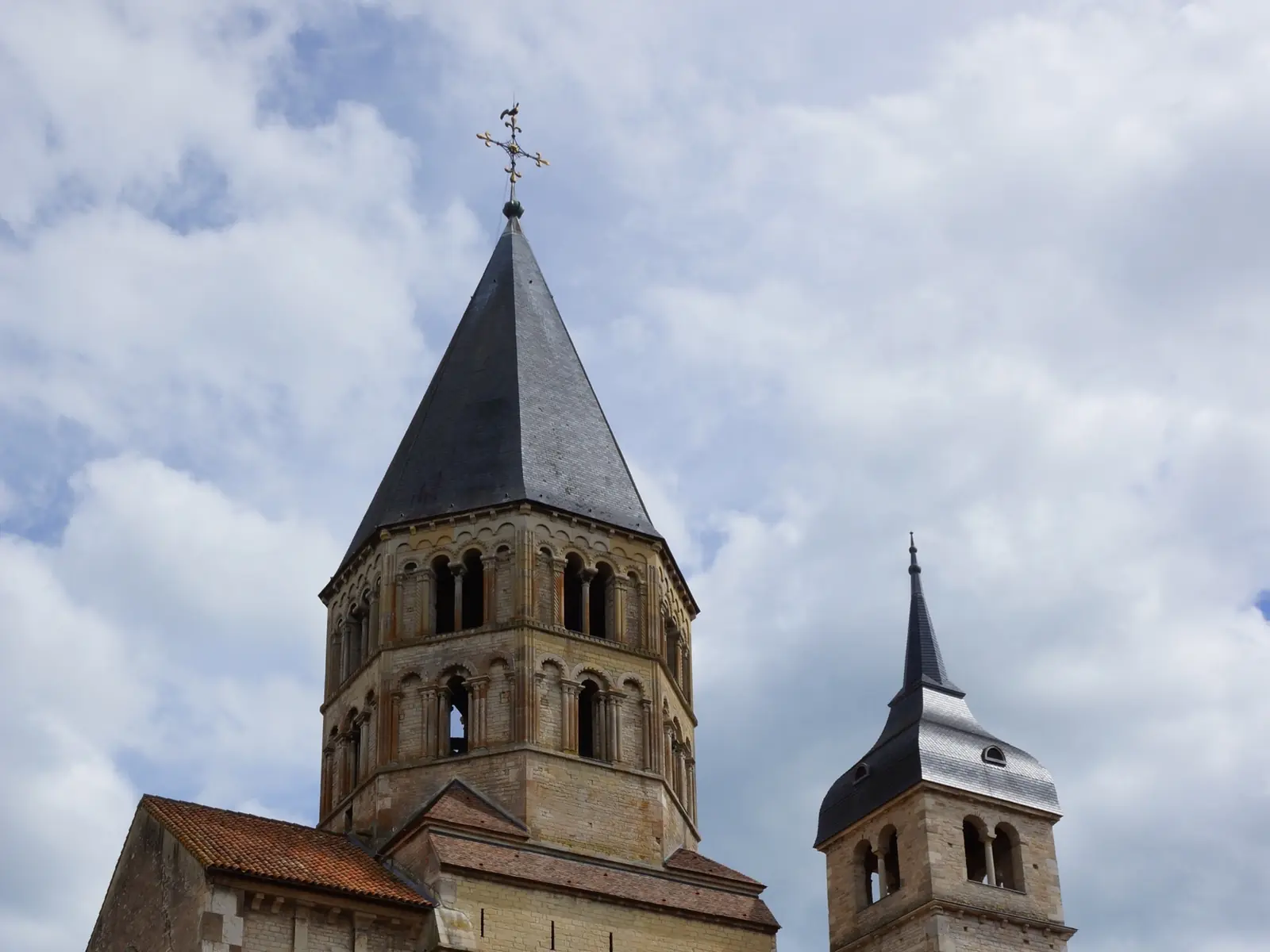
Pope Callixtus II canonized Hugh on January 6, 1120, and his feast is kept on April 29. At the request of Pope Honorius III his remains were translated on May 23, 1220. In 1575 the Huguenots destroyed his shrine and his remains, and only a few relics were saved. The abbey was suppressed at the Revolution, and its great church was sold and pulled down for its stone; part of the south transept still stands.
In art
A manuscript in the Bibliothèque nationale de France in Paris (Latin 17716) has two well-known miniatures of Hugh’s great church: one shows the vision of Gunzo, the other the consecration of the church. At Berzé-la-Ville the upper chapel of the monks’ priory keeps wall paintings of the twelfth century, with Christ in glory among the apostles in the apse and scenes from the life of Saint Blaise. The Ministry of Culture calls them the only witnesses of Cluniac monumental painting at the height of the abbey.
Where to pray
- Semur-en-BrionnaisHis birthplace, with the castle of the lords of Semur and the church of Saint-Hilaire, built by his family in the second half of the twelfth century.
- ClunyThe abbey he governed for sixty years, where part of the church he began in 1088 still stands, now a monument open to visitors.
- Berzé-la-VilleThe Chapelle des Moines of the priory he founded, with its twelfth-century paintings, open for guided visits from April to October.
- Paray-le-MonialThe priory church rebuilt under Hugh, now the basilica of the Sacred Heart.
On our ways: Cluny, Berzé-la-Ville, Paray-le-Monial.