The holy places of France · Provence-Alpes-Côte d’Azur
Avignon The Palace of the Popes and Notre-Dame-des-Doms
Vaucluse, Provence-Alpes-Côte d’Azur
- Feasts
- April 14, September 2
- Getting there
- High-speed trains from the Gare de Lyon in Paris reach Avignon TGV, south of the city, in about 2 hours 40 minutes, with a shuttle train or a 15-minute bus into town; one…
- On our way
- Via Magdalenae
Why the popes came to Avignon
Clement V, elected pope in 1305 after the quarrel between King Philip IV of France and Pope Boniface VIII, came to Avignon in 1309, partly because of the affair of the Templars. The town belonged to the counts of Provence and lay beside the papal lands of the Comtat Venaissin. He stayed there only from time to time and lodged with the Dominicans.
His successor, John XXII, was Jacques Duèse, born at Cahors and bishop of Avignon since 1310. Elected at Lyon in 1316, he settled in the bishop’s palace beside the cathedral. In that cathedral, on July 18, 1323, he canonized Saint Thomas Aquinas.
Benedict XII, Jacques Fournier, razed the bishop’s palace and built a papal palace in its place. Clement VI enlarged it and, on June 9, 1348, bought Avignon from Queen Joanna of Naples, countess of Provence, for 80,000 florins. Urban V took the papacy back to Rome in 1367, urged on by Saint Bridget of Sweden, but returned to Avignon in 1370 and died soon after.
Gregory XI, a nephew of Clement VI, was elected at Avignon in 1370. In 1376 the Florentines sent Saint Catherine of Siena to plead with him, and the Catholic Encyclopedia records that he decided on the return to Rome in answer to her urgent prayers, against the wishes of the French king and most of the cardinals. He left Avignon on September 13, 1376, and entered Rome on January 17, 1377. He was the seventh and last pope to reign at Avignon.
The schism and the papal city
Gregory XI died in Rome in March 1378. After the election of Urban VI, cardinals who rejected him met at Fondi and chose Robert of Geneva, who took the name Clement VII and returned to Avignon. The Great Western Schism lasted until 1417. The Church counts the Roman popes of these years as the legitimate line, and Clement VII and his successor at Avignon as antipopes.
That successor, Pedro de Luna, took the name Benedict XIII in 1394. Besieged in the palace from 1398, he remained confined there for five years and fled in March 1403. He was deposed twice and never gave up his claim.
Avignon remained a papal city, governed by a legate or a vice-legate, until the Constituent Assembly decreed its union with France on September 14, 1791. In 1475 Pope Sixtus IV had raised the diocese to an archdiocese for his nephew Giuliano della Rovere, the future Julius II.
The Palace of the Popes
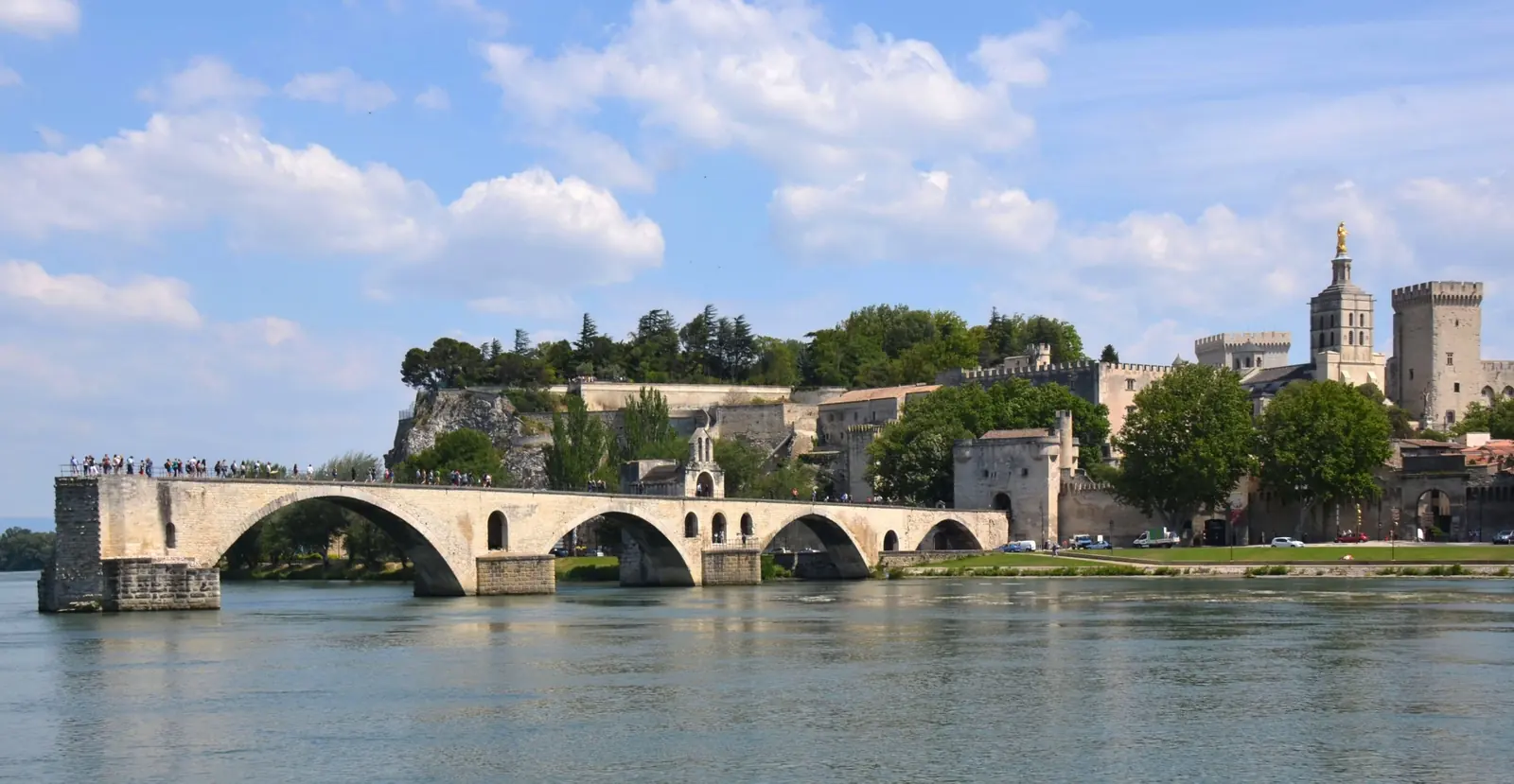
The palace was built from 1335 to 1352 on the Rocher des Doms, above the Rhône. With about 160,000 square feet of floor space, it is the largest Gothic palace in Europe. The Palais Vieux of Benedict XII, by Pierre Poisson, is built around a cloister flanked by high towers, and the Palais Neuf of Clement VI, by Jean de Louvres, added the Great Chapel. In the nineteenth century the army used the palace as a barracks, and much of its painting was lost. Restoration began after the troops left in 1906, and UNESCO listed the palace, the cathedral quarter and the bridge as World Heritage in 1995.
The Great Chapel, about 171 feet long, was the setting of solemn papal ceremonies. In the Saint John tower are two small chapels, one above the other, painted by Matteo Giovannetti, a priest from Viterbo who worked for Clement VI. He painted the upper chapel, dedicated to Saint Martial, in 1344 and 1345. The chapel of Saint John below, painted in 1347 and 1348, has scenes of the two Saints John, the Baptist and the Evangelist. Photography is not allowed there.
Works on the palace are planned to last until spring 2027, with new routes, and some rooms close for a few days at a time. There are many stairs, and a shorter route is offered to visitors with reduced mobility. Check palais-des-papes.com before the visit.
Notre-Dame-des-Doms and the Rocher
The cathedral stands beside the palace. It is first mentioned in 1037, and the present Romanesque church dates from the twelfth century, remodeled in the fifteenth and seventeenth. It was raised to metropolitan rank in 1475 and made a minor basilica in 1854. The building belongs to the French state. It is the cathedral of the archdiocese of Avignon, led by Archbishop François Fonlupt, and the priests of the parish of Avignon Intra-Muros serve it together with Saint-Pierre, Saint-Didier and Saint-Agricol.
Its side chapels hold the Gothic tombs of John XXII and Benedict XII. In 1859 a statue of the Virgin in gilded lead, weighing about 10,000 pounds, was set on the bell tower. From Christmas to February 2 a chapel holds a large Provençal crèche whose santons were made in the nineteenth century by the Carmelites of Avignon.
Above the palace is the nineteenth-century garden of the Rocher des Doms, with views over the Rhône as far as Mont Ventoux. It reopened in February 2026 after a first phase of restoration; a second phase, due to finish before summer 2027, may close parts of it again.
Saint Bénézet and the bridge
According to the legend, Bénézet, a young shepherd, heard a voice from heaven telling him to build a bridge over the Rhône at Avignon, where many poor people drowned trying to cross. A churchman challenged him to throw a huge block of stone into the river, and the story says that he did so with God’s help. Work began in 1177 with the bishop’s approval, and Bénézet directed it until his death in 1184.
That bridge was destroyed in 1226, during the siege of Avignon by King Louis VIII. It was rebuilt in stone from 1234, with 22 arches, over half a mile long. Floods kept bringing down arches, and after the flood of 1669 the bridge was abandoned. Four arches remain, and on one of the piers stands the chapel of Saint Nicholas, on two levels, where Bénézet was buried.
Miracles reported at his tomb spread his cult. His coffin was taken from the bridge after the flood of 1669, and in 1674 the archbishop of Avignon carried his body in solemn translation to the church of the Celestines. Today the church of Saint-Didier holds some of his relics. He is patron of bridge builders, and his feast is April 14.
The Pénitents gris and the old churches
The Devout and Royal Company of the Gray Penitents traces its origin to 1226. As the confraternity tells it, after the siege of Avignon King Louis VIII, father of Saint Louis, put on a gray sackcloth on September 14 and came to adore the Blessed Sacrament in the chapel of the Holy Cross, in reparation for outrages by the Albigensians. The confraternity was founded to keep the Sacrament adored, and its tradition dates the perpetual adoration of the chapel to that year.
In 1433 the Rhône and the Sorgue overflowed and flooded the chapel. According to the confraternity, the first master and two penitents came by boat to save the Host and found that the waters had parted, leaving the altar dry, and that they stayed so for three days. The confraternity keeps the memory on November 30, the feast of Saint Andrew, though the manuscripts also give November 28 or 29. On the Sunday after that feast the penitents climb the nave on their knees, hooded and with a cord around the neck. The chapel, at 8 rue des Teinturiers, opens mainly for its services: a Sunday morning Mass in the older form of the Roman rite and adoration on the first Friday of the month. The regional tourist board also lists an opening on the first Saturday afternoon of the month.
Three other churches stand a short walk from the palace. The basilica of Saint-Pierre, founded as a collegiate church in 1358, has walnut doors carved in the sixteenth century by Antoine Volard. Saint-Didier, a plain church in the southern Gothic style consecrated in 1359, holds relics of Saint Bénézet and a marble altarpiece carved by Francesco Laurana for King René. Saint-Agricol holds the relics of Saint Agricol, a seventh-century bishop of Avignon and patron of the city, invoked for rain in times of drought.
Villeneuve-lès-Avignon and the way home
Across the Rhône, at Villeneuve-lès-Avignon, Innocent VI gave his former residence to the Carthusians, and the church of the Charterhouse of the Val de Bénédiction was begun in 1353. He died on September 12, 1362, and was buried in its Trinity chapel under a flamboyant Gothic tomb of Pernes stone, which the Charterhouse describes as the most complete tomb of a French pope. Moved to the town hospice in 1835, the tomb returned to the church in 1959. A nearby chapel has frescoes of Saint John the Baptist attributed to Matteo Giovannetti.
Groups on our Via Magdalenae reach Avignon at the end of the week, after Saintes-Maries-de-la-Mer, Arles, Saint-Maximin, La Sainte-Baume, Le Thoronet and Sénanque, and take the high-speed train back to Paris after a day and a night. Most trains leave from Avignon TGV, south of the city and linked to Avignon Centre station by a shuttle train, and reach the Gare de Lyon in about 2 hours 40 minutes. The Charterhouse is closed on Mondays outside the summer.
To see and to pray
- The Palace of the PopesThe Great Chapel and the chapels of Saint Martial and Saint John, painted by Matteo Giovannetti in the 1340s.
- Notre-Dame-des-DomsThe Romanesque cathedral, with the Gothic tombs of John XXII and Benedict XII and the gilded Virgin of 1859 on its tower.
- The Rocher des DomsThe garden above the palace, with views over the Rhône, reopened in 2026; a second phase of works is due to end before summer 2027.
- The Saint-Bénézet bridgeFour arches of the medieval bridge and the chapel of Saint Nicholas on one of its piers, where Saint Bénézet was buried.
- The chapel of the Pénitents grisThe chapel of a confraternity that dates its foundation and its adoration of the Blessed Sacrament to 1226, known for the miracle of the waters of 1433.
- Saint-DidierA Gothic church consecrated in 1359, with relics of Saint Bénézet and a marble altarpiece by Francesco Laurana.
- Saint-Pierre and Saint-AgricolThe carved walnut doors of Saint-Pierre, and the relics of Saint Agricol, patron of Avignon, in the church that bears his name.
- The Charterhouse of VilleneuveAcross the Rhône, the tomb of Innocent VI and frescoes attributed to Matteo Giovannetti.
When to go
Entry to Notre-Dame-des-Doms is free. From October through December it is closed on Mondays, and its hours depend on the volunteers who keep it open, so check the tourist office listing before going. The Palace of the Popes and the bridge are open every day of the year, and works at the palace, planned until spring 2027, can close some rooms for a few days.
From Christmas to February 2 the cathedral shows its Provençal crèche. The Pénitents gris keep the memory of the miracle of the waters on the Sunday after November 30. In July the city is crowded for the Festival d’Avignon, and rooms should be booked well ahead. The Charterhouse of Villeneuve is closed on Mondays outside the summer, and on January 1, May 1, November 1 and December 25.
Mass and prayer
Notre-Dame-des-Doms, Saint-Pierre, Saint-Didier and Saint-Agricol are served by the priests of the parish of Avignon Intra-Muros, in the archdiocese of Avignon, whose archbishop is François Fonlupt. Mass is said every day in at least one of these churches, and there is weekday adoration at Saint-Pierre and Saint-Agricol; the parish publishes its weekly sheet with the times on avignonintramuros.paroisse84.fr.
The chapel of the Pénitents gris, 8 rue des Teinturiers, opens mainly for its services, and on the first Saturday afternoon of the month. The confraternity, which dates its perpetual adoration to 1226, now holds a Sunday Mass in the older form of the Roman rite and adoration on the first Friday of the month; the parish sheet gives the times.
Walking and access
The palace has many stairs, and a shorter route is offered to visitors with reduced mobility. The square in front of the palace slopes steeply and is paved with cobbles. A ramp reaches the cathedral forecourt (a manual wheelchair needs a companion), but there are steps into the cathedral.
The bridge is accessible to visitors with reduced mobility. Saint-Agricol can be reached by ramps that avoid the stairs, with one step at the door. The Rocher des Doms garden reopened in February 2026; a second phase of works, due to finish before summer 2027, may close parts of it again, so check with the tourist office. The Charterhouse of Villeneuve has an access ramp.
Feasts
- April 14Feast of Saint Bénézet, the shepherd who began the bridge of Avignon in 1177.
- September 2Feast of Saint Agricol, bishop of Avignon in the seventh century and patron of the city, whose relics are in the church of Saint-Agricol.
- November 30Feast of Saint Andrew and memory of the miracle of the waters of 1433; on the following Sunday the Pénitents gris climb the nave of their chapel on their knees.
- December 25 to February 2A large Provençal crèche, with nineteenth-century santons made by the Carmelites of Avignon, in Notre-Dame-des-Doms.
On our way
Getting there
High-speed trains from the Gare de Lyon in Paris reach Avignon TGV, south of the city, in about 2 hours 40 minutes, with a shuttle train or a 15-minute bus into town; one or two direct trains a day reach Avignon Centre in about 3 hours 40 minutes.
The shrine’s own website, for times and news: diocese-avignon.fr
Questions
Is the cathedral free?
Yes, and so are Saint-Agricol and the chapel of the Pénitents gris. The Palace of the Popes, the bridge and the Charterhouse of Villeneuve charge admission.
How long should we stay in Avignon?
A full day covers the palace, the cathedral and the bridge. A night allows Mass in the old town and, before the train, a visit across the river to the Charterhouse of Villeneuve and the tomb of Innocent VI.
Which station should we use?
Most high-speed trains from Paris stop at Avignon TGV, south of the city, which is linked to Avignon Centre by a shuttle train and by buses of about 15 minutes. Two or three direct trains a day run to Avignon Centre itself.
Can we visit the chapel of the Pénitents gris?
Mainly during services, so plan to attend the Sunday Mass or the first-Friday adoration; the regional tourist board also lists an opening on the first Saturday afternoon of the month. The confraternity keeps the memory of the miracle of the waters of 1433 on the Sunday after November 30.
Sources
- Les 9 papes à Avignon (Palais des Papes)
- Le parcours de visite (Palais des Papes)
- Avignon (Catholic Encyclopedia, New Advent)
- Pope Gregory XI (Catholic Encyclopedia, New Advent)
- Palais des Papes (Wikipedia)
- St. Bénézet (Encyclopaedia Britannica)
- Basilique Métropolitaine Notre-Dame des Doms (Provence-Alpes-Côte d’Azur Tourisme)
- Feuille paroissiale d’Avignon Intra-Muros, May 10, 2026 (Diocese of Avignon)
- Sources on the flood of 1433 at Avignon (ANR Dikida, CEREGE)
- Visit sheets of the Charterhouse of Villeneuve-lès-Avignon (La Chartreuse)
- Pénitents Gris d’Avignon, restoration appeal of the confraternity (Credofunding)
- La Chartreuse, Centre national des écritures du spectacle (Provence Guide)
- From Paris to Avignon by train (Show Me the Journey)
- SNCF Connect, Paris to Avignon Centre train times
- SNCF Connect, Paris to Avignon train times
- Palais des Papes (official site), Le plus grand palais gothique
- Encyclopaedia Britannica, Avignon papacy
- Wikipedia, Pope Gregory XI
- Frommer’s, Cathédrale Notre-Dame des Doms
- Horizon Provence, The Palace of the Popes in Avignon
Facts checked against these sources on .
Nearby
- SénanqueThe Abbey of Notre-Dame de Sénanque, about 19 miles as the crow flies
- ArlesSaint-Trophime, about 21 miles as the crow flies
- Saintes-Maries-de-la-MerThe Church of the Saintes-Maries, about 39 miles as the crow flies
- Saint-MaximinThe Basilica of Saint Mary Magdalene, about 63 miles as the crow flies